Reported questions and commands
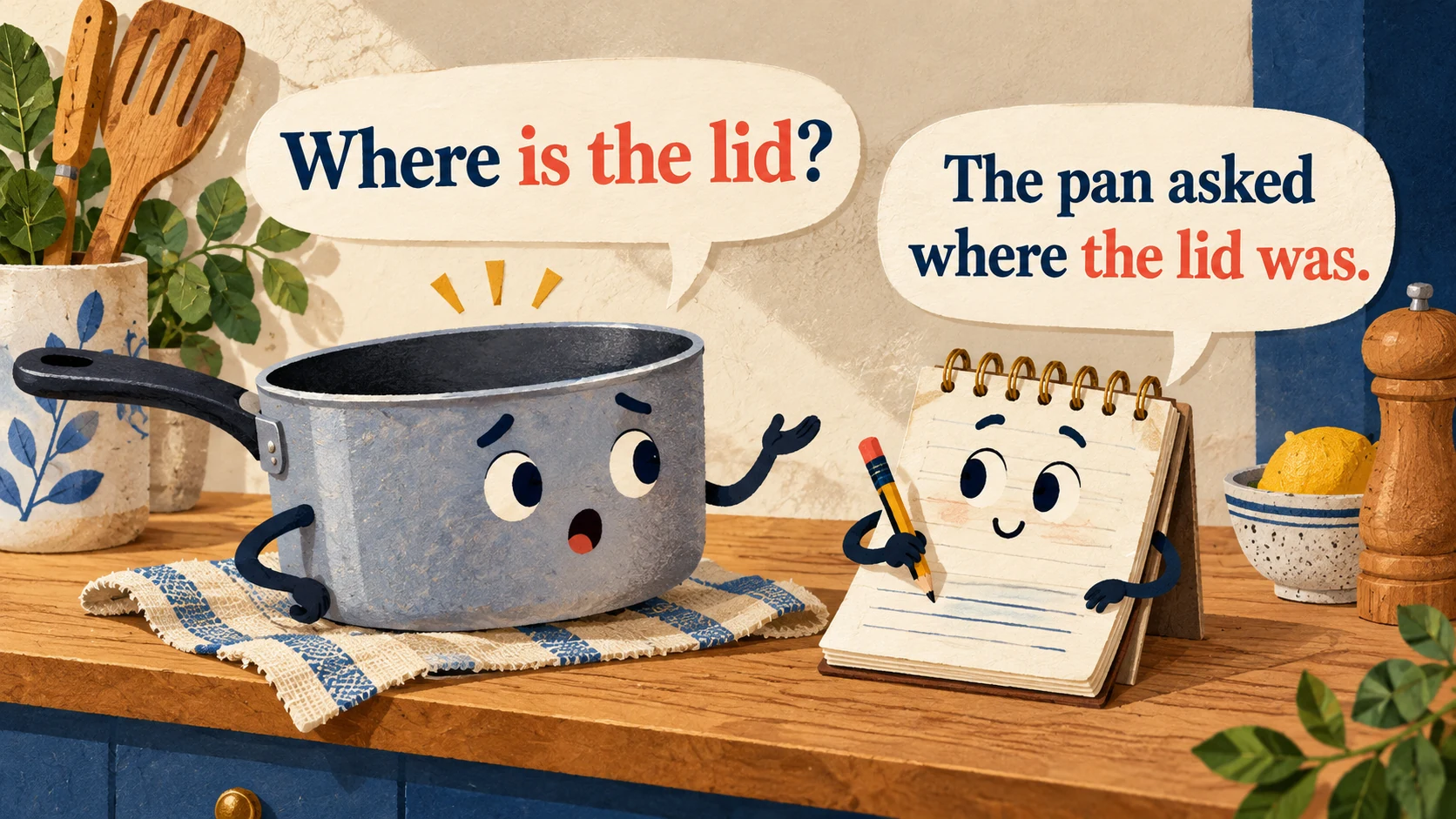
“Where do you live?” becomes “She asked where I lived.” We keep the question’s meaning but use statement word order after asked.
Report a question
For a yes/no question, use asked + if/whether + subject + verb:
- “Are you ready?” → He asked if I was ready.
- “Does she work here?” → They asked whether she worked there.
For a question-word question, keep the question word:
- “Where do you work?” → She asked where I worked.
- “What are you doing?” → He asked what I was doing.
In the reported clause, do not use question inversion: She asked where did I work → She asked where I worked. A reported question usually ends with a full stop when the whole sentence is a statement.
Remove the question order inside the report
The direct question Where does Nina work? uses does to build a present-simple question. A report uses Nina before the verb:
He asked where Nina worked.
Remove does and put the tense on worked. Compare the same change with be:
“Where is Nina?” → He asked where Nina was.
The reported clause is where Nina was, not where was Nina. The reporting verb asked tells us that someone asked a question; the inner clause does not need question order.
| Direct question | Reported question |
|---|---|
| “Are you busy?” | She asked if I was busy. |
| “Can you swim?” | She asked whether I could swim. |
| “What are you reading?” | She asked what I was reading. |
| “When did you arrive?” | She asked when I had arrived. |
For a yes/no question, if and whether introduce the missing connection. You cannot normally say She asked I was busy.
A past reporting viewpoint often leads to a past form, but the pronouns must still fit the participants. You may become I, he, she or they, depending on who received the original question.
Report an instruction or request
Use told/asked + person + to + base verb:
- “Close the window,” the teacher said. → The teacher told us to close the window.
- “Please wait here,” she said. → She asked me to wait there.
For a negative instruction, use not to: The guide told us not to touch the paintings.
Keep the viewpoint clear
You may need to change pronouns, place and time words. “Can you come tomorrow?” may become He asked if I could come the next day. First decide who you refers to in the new report.
A question and a request can use the same original words
“Can you open the window?” has the form of a question, but it often functions as a request. You can report the intention as She asked me to open the window.
If someone genuinely asked about your ability to open a difficult window, She asked if I could open the window may be more accurate. Choose the report that preserves the intended meaning.
Instructions use a person plus an infinitive
“Wait outside.” → The tutor told us to wait outside.
“Please send the form.” → The tutor asked me to send the form.
“Don't touch the wire.” → The tutor told me not to touch the wire.
The person after told/asked receives the instruction and performs the action. Told to wait alone leaves that person missing in this active pattern.
Put not before to for the usual negative instruction pattern: asked us not to talk. Asked us to not talk can also occur in English; not to is a useful standard choice, rather than a reason to treat every split infinitive as ungrammatical.
Keep the outer sentence separate from the inner clause
She asked where the station was is a statement reporting a question, so it ends with a full stop.
Did she ask where the station was? is a question to your current listener. The main clause uses Did she ask ...? and ends with a question mark. The inner part where the station was still keeps subject-verb order.
Try reporting a short exchange: The receptionist asked whether I had an appointment. She then asked me to wait and told me not to enter the office yet. It contains a reported question, a request and a negative instruction. Each pattern has its own job.
Sources and further reading
Try this structure in a short practice set with instant feedback.
Start practice