Modals of deduction
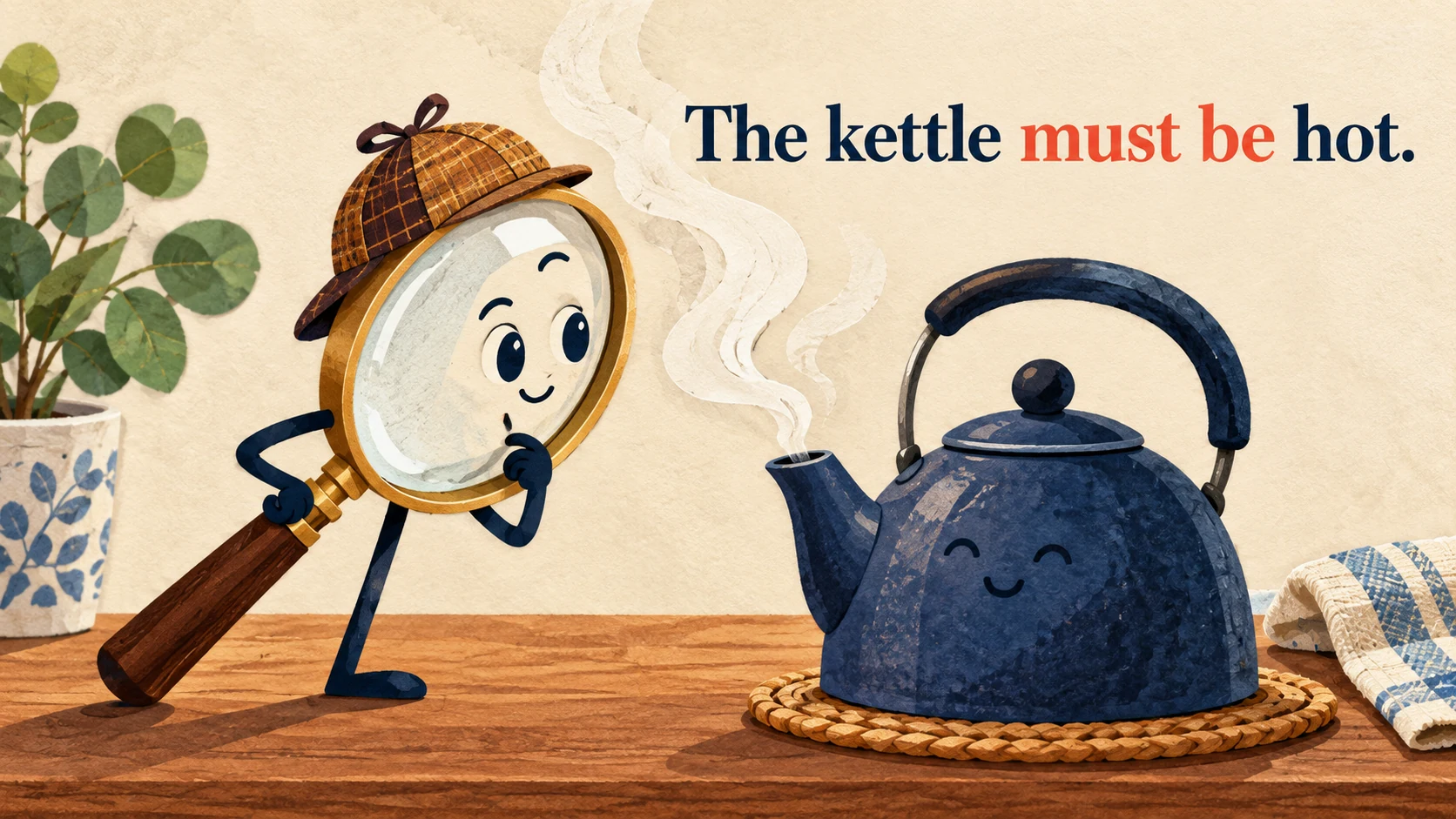
The lights are on, but nobody answers. “They might be out in the garden.” You are using clues to make a careful guess.
From strong conclusion to possibility
Use a modal before the base form of the verb. With be, the pattern is modal + be:
| What the clues suggest | Example |
|---|---|
| Strong conclusion | She must be at work; her car is there. |
| Real possibility | She might/may/could be at work. |
| Strong negative conclusion | She can’t be at work; the office is closed. |
Must here means “I think this is almost certainly true”, not “she is required to”. Can’t means “I think this is impossible”, not “she is forbidden”.
Let the strength of the evidence guide your wording
Suppose a bicycle is parked outside a café. You recognise it as Ben's. What can you say?
| Evidence | Sentence | What you mean |
|---|---|---|
| You recognise the bike and know Ben visits this café. | Ben must be inside. | That is your strong conclusion. |
| The bike looks similar, but you are not sure. | Ben might be inside. | It is one possible explanation. |
| You know Ben is in another country today. | It can't be Ben's bike. | You reject that explanation. |
Must does not mean you directly saw Ben. You are drawing a conclusion from clues. A deduction may still be mistaken if the evidence is misleading.
May, might and could all express possibilities in this use. They do not form a fixed percentage scale. It might be Ben is a natural cautious guess.
A negative possibility is different from a negative conclusion
She might not be at home means it is possible she is elsewhere. She can't be at home expresses a much stronger judgement that being there is impossible in the circumstances.
Do not use mustn't as the normal opposite of deduction must. You mustn't enter expresses prohibition. For a strong negative deduction, use can't: That can't be the entrance; the sign says “Staff only”.
Use evidence and context
- That must be Dan at the door. He said he’d arrive at six.
- It could be Dan, but I haven’t looked.
- It can’t be Dan. He’s abroad this week.
A deduction is still a judgement. If you know the fact directly, simply state it: Dan is at the door.
Form matters
Use must/might/may/could/can’t + base verb:
- He might know the answer.
- They must live nearby.
- She can’t be asleep.
Do not add to after these modals. To make a deduction about the past, English uses a different pattern; that comes at B2.
The form follows the modal, not the subject
Use the base verb after the modal: She might know, not she might knows. Must, may, might, could and can't do not take -s with he/she/it, and they do not require to.
With a state, use a simple pattern: He must need a break; They might live nearby. With an activity happening now, use modal + be + -ing:
He isn't answering. He might be driving.
I can hear a piano. Someone must be practising.
Be stays in the base form after the modal. Avoid might is driving. The -ing part shows the activity in progress.
One modal can express different meanings
You must wear a badge is an obligation. You must be the new tutor is a deduction based on the situation. To interpret must, ask whether the speaker is setting a requirement or judging what is true.
Likewise, She can't swim describes lack of ability; That can't be her car rejects a possibility. The surrounding words tell you which meaning applies.
Consider a conversation:
A: Jo's desk is empty.
B: She may be in a meeting.
A: Her coat is gone too, and it's six o'clock.
B: Then she must be on her way home.
The second speaker becomes more confident after receiving more evidence. This is why modal choice should be based on what you know, rather than on the answer you hope is true.
For your own practice, give a reason after each deduction: He must be tired because ...; It might be a mistake because ...; It can't be correct because .... If the reason is weak, choose a possibility form. If you know the fact directly, you can simply state it without a deduction modal.
Sources and further reading
Try this structure in a short practice set with instant feedback.
Start practice