Reported statements
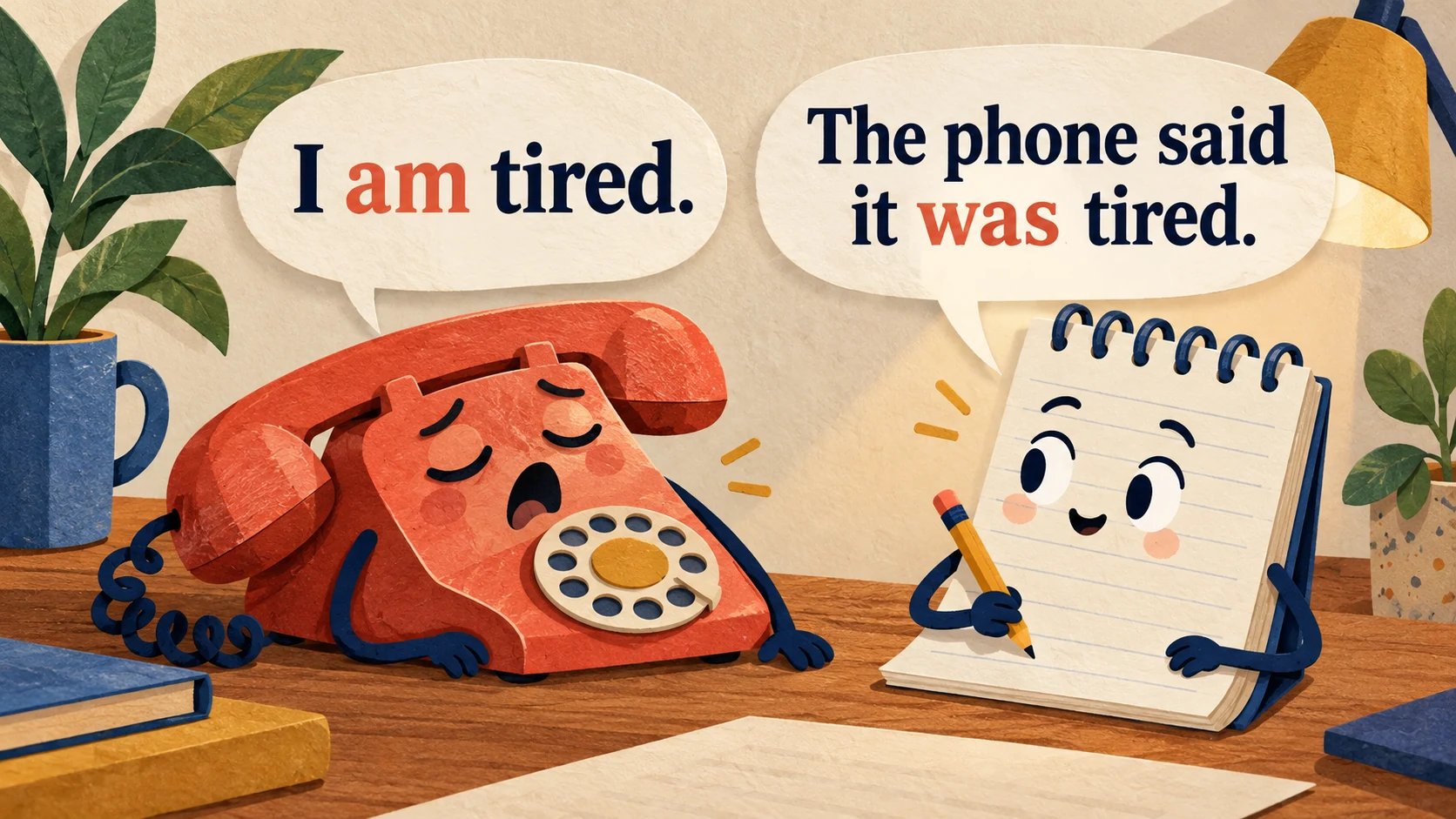
“I’m tired,” Ana said. Later, you tell a friend: “Ana said (that) she was tired.” Reporting changes the viewpoint.
Start with the reporting verb
Use say (that) + clause or tell + person + (that) + clause:
- He said (that) he was busy.
- He told me (that) he was busy.
Do not say He said me. Tell normally needs the person receiving the message; say does not take that direct object.
Change the viewpoint
When the reporting verb is in the past, the original words often move one step back in tense:
| Direct words | Reported statement |
|---|---|
| “I am ready.” | She said she was ready. |
| “We work here.” | They said they worked there. |
| “I will call.” | He said he would call. |
Pronouns and time/place words may change too: I → she, here → there, tomorrow → the next day. Change only what the new speaker’s viewpoint requires.
Follow the message instead of swapping words mechanically
On Monday, Eva tells you “I live near the station.” Later, you report:
Eva said she lived near the station.
I becomes she because Eva was speaking about herself. Live becomes lived because you are presenting the message from the earlier conversation.
Now imagine Eva said “Your brother lives near the station.” The report is Eva said my brother lived near the station. The person described is your brother, not Eva. Pronouns must follow the intended people.
Common changes from a past viewpoint
| Original message | Common reported version |
|---|---|
| “I'm studying.” | She said she was studying. |
| “I've finished.” | She said she had finished. |
| “I can help.” | She said she could help. |
| “I'll call.” | She said she would call. |
| “I was late.” | She said she had been late. |
The earlier-past forms in the last column make the time relationship clear. At B1, recognise them and use the full message context to understand what happened before the reporting.
That is usually optional after said/told: She said that she was tired and She said she was tired have the same basic meaning. Unlike direct speech, the report normally has no quotation marks.
Is backshift always necessary?
If the fact is still true, the original tense can sometimes remain: The guide said the museum is free on Sundays. If you are reporting a past conversation and do not know whether it is still true, was may be safer. Context decides.
Build it in three steps
- Decide who spoke and who is being described.
- Choose said or told + person.
- Adjust tense, pronouns and time expressions so the new sentence makes sense now.
Direct: “I can help you tomorrow,” Luis said.
Reported: Luis said he could help me the next day.
Time and place belong to the speaker's viewpoint
On Monday in the classroom, Sam says “I'll bring the book here tomorrow.”
If you report immediately from the classroom, you can say Sam says he'll bring the book here tomorrow. If you report on Wednesday from home, Sam said he would bring the book to the classroom the next day is clearer. The next day refers to Tuesday, the day after Sam spoke.
You can avoid confusion by naming the date or place: Sam said he would bring the book to the classroom on Tuesday. Here → there and tomorrow → the next day are common changes, but they are not automatic when the situation has not changed.
Said and told need different connections
She said she was busy reports a message. She told me she was busy also names the listener. To name the listener with say, use to: She said to me that she was busy. She told me ... is often more natural.
Do not write She said me or She told that she was busy when reporting this statement. Tell normally requires the person receiving it in this construction.
Backshift does not prove the fact is now false. He said he worked in a bank may describe someone who still works there. He said he works in a bank can emphasise that the information remains current.
A complete report can separate the earlier message from later knowledge: He told me he worked in a bank, but now he teaches. The final clause establishes the change.
To carry a message accurately, first identify the original speaker and listener, then choose said/told, and finally check time, place and pronouns. Understanding who meant what, when is more useful than memorising a tense-change table alone.
Sources and further reading
Try this structure in a short practice set with instant feedback.
Start practice