Obligation, prohibition and permission
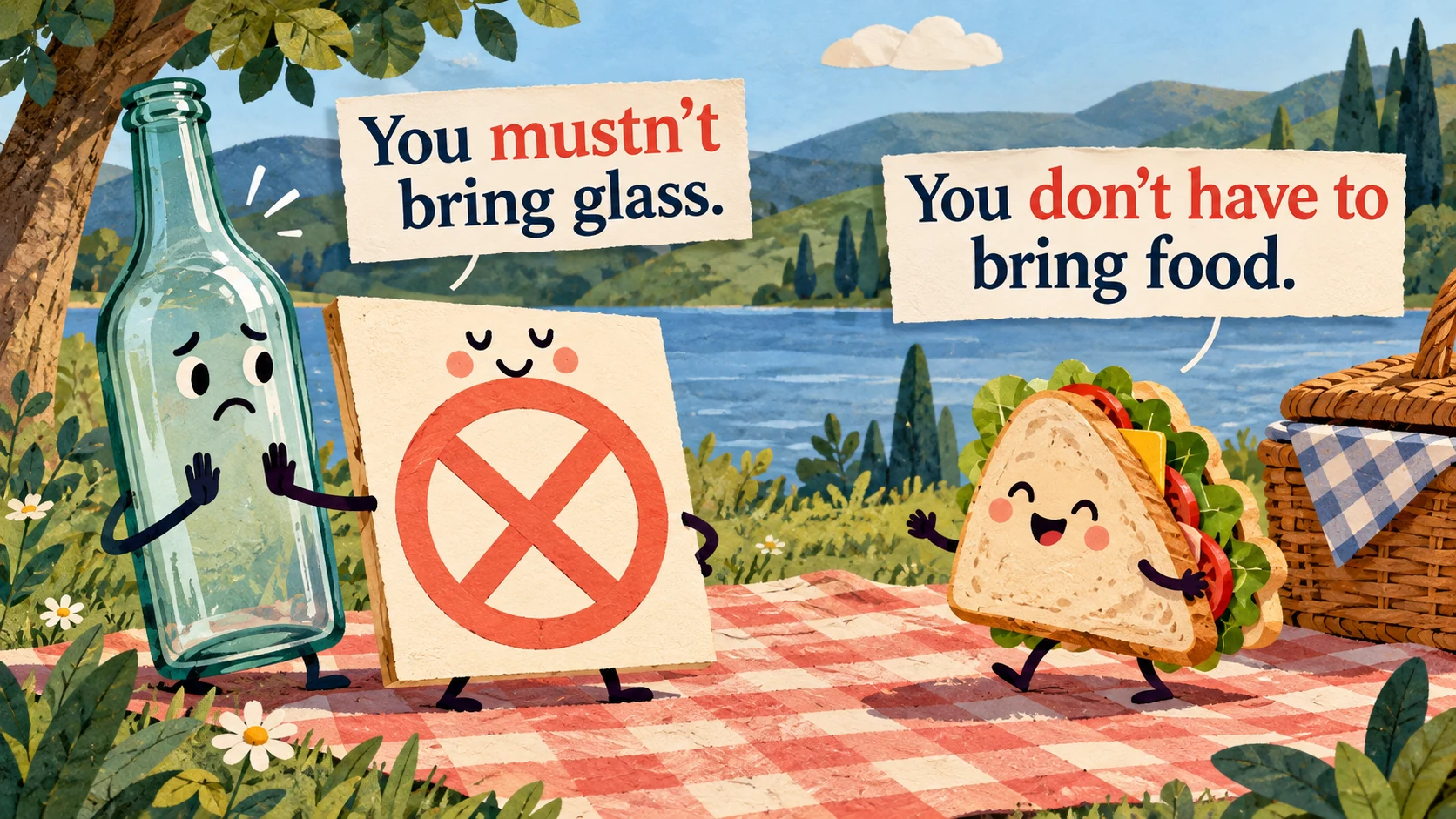
“You must wear a helmet” and “You don’t have to wear a helmet” are very different messages. The negative form changes the rule.
Four meanings to keep apart
| Meaning | Example |
|---|---|
| Obligation | You must show your ticket. / You have to show your ticket. |
| No obligation | You don’t have to book in advance. |
| Prohibition | You mustn’t park here. / You can’t park here. |
| Permission | You can use this entrance. / You may use this entrance. |
Must and have to both express obligation. In many everyday situations either works. Have to is especially common when talking about an external rule or routine; must can sound more direct or formal.
Watch the negatives
Mustn’t means do not do this.
Don’t have to means you can choose whether to do it.
- You mustn’t bring food into the lab. Food is prohibited.
- You don’t have to bring food. Bringing food is optional.
This is the most important contrast in the lesson.
Read a notice as a decision about your options
Imagine a sports centre with four notices:
| Notice | Meaning for the visitor |
|---|---|
| You must shower before swimming. | Showering is required. |
| You mustn't dive here. | Diving is forbidden. |
| You can use a locker. | A locker is available for you to use. |
| You don't have to bring a towel. | Bringing one is optional. |
Don't have to is not the negative of must in meaning. It removes necessity, while mustn't forbids the action.
Compare You don't have to wait outside with You mustn't wait outside. The first gives you a choice. The second says outside is not an allowed place to wait.
Have to uses ordinary verb grammar
| Purpose | Example |
|---|---|
| Statement | She has to wear a badge. |
| Negative | She doesn't have to wear a badge. |
| Question | Does she have to wear a badge? |
| Past requirement | She had to wear a badge yesterday. |
| Future requirement | She'll have to wear a badge tomorrow. |
After does/doesn't, use have, not has. Must does not follow this pattern: She must wear a badge, without -s or to.
For an ordinary past obligation, use had to, not musted. For a past prohibition, wasn't/weren't allowed to is useful: We weren't allowed to take photos.
Form and tone
Must, mustn’t, can and may take a base verb without to: You must leave, not must to leave. Have to changes with the subject and tense: She has to leave; We had to leave.
For a polite request for permission, Could I leave early? is often softer than Can I leave early? May I…? can sound formal.
Ask for permission and give a clear answer
A: Could I leave my bag here?
B: Yes, you can. But you must collect it before six.
Could I ...? softens the request. The reply Yes, you can gives present permission; you do not have to repeat could. May I ...? is another option, often more formal.
Be allowed to works across tenses: We're allowed to use the room, We were allowed to leave early, We'll be allowed to return tomorrow. It is helpful when can might be confused with ability.
A strong requirement and advice are different
You must bring your passport presents it as required. You should bring a jacket recommends it. Should is advice, not normally a strict rule.
Must and have to often overlap. I must remember to call Dad can express a strong personal intention. I have to show ID at work describes a regular requirement. Avoid turning this useful tendency into an absolute rule that must can never refer to an external rule.
To describe a school or workplace, choose the meaning before the form: We have to arrive by nine. We can use the kitchen. We mustn't leave the fire exit blocked. We don't have to wear a uniform.
These sentences answer four separate questions: What is required? What is allowed? What is forbidden? What is optional? If you keep those questions separate, the negative forms become much easier to understand.
When correcting She musts to pay, remove both unnecessary parts: She must pay. When correcting She don't have to pay, use doesn't with the singular subject: She doesn't have to pay. Each construction has its own grammatical pattern.
Sources and further reading
Try this structure in a short practice set with instant feedback.
Start practice