Future forms: plans, arrangements and predictions
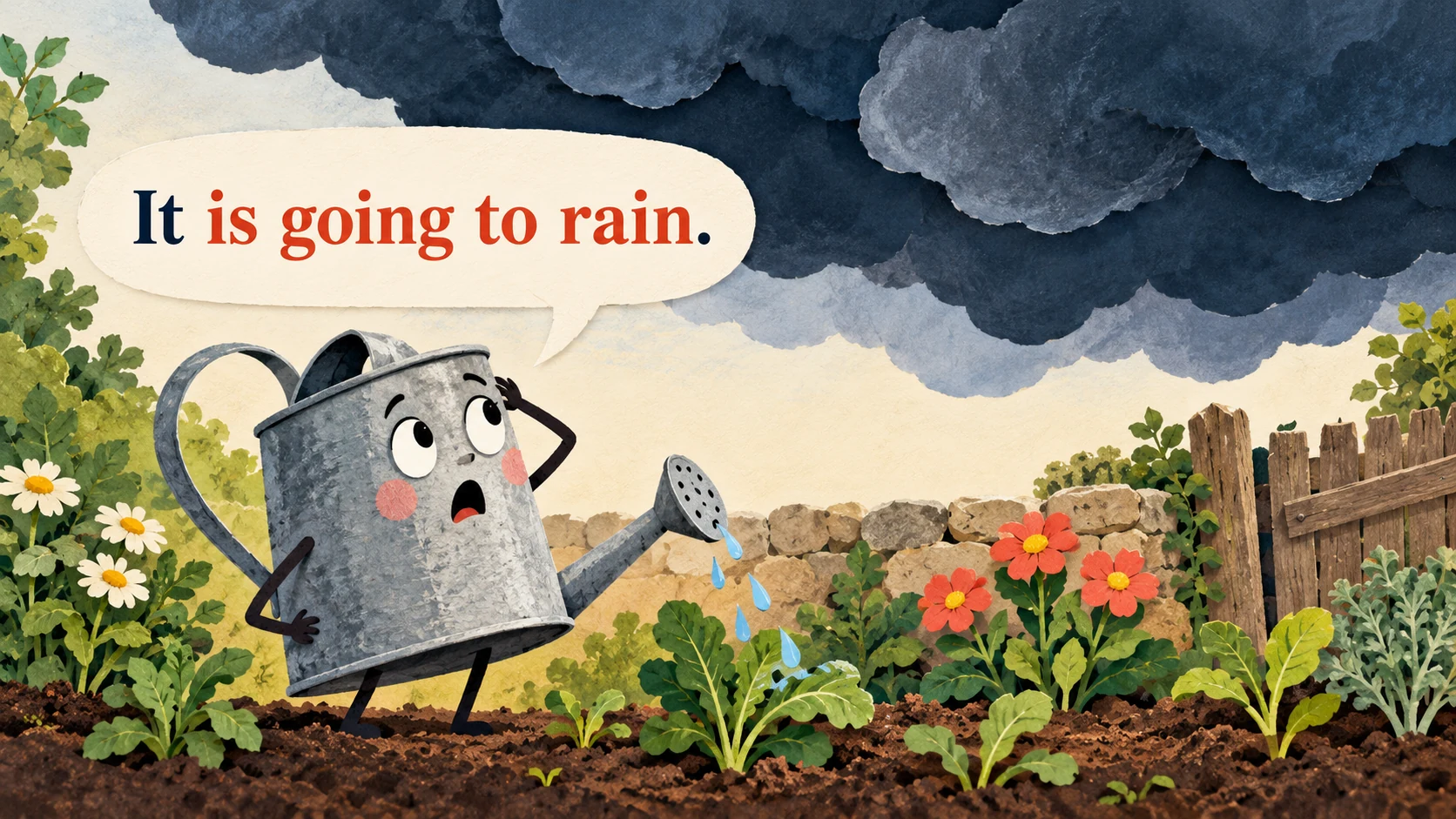
“I’ll call you,” “I’m going to call you” and “I’m calling you at six” all look ahead, but they present the future in different ways.
Choose the meaning first
| Form | Common use | Example |
|---|---|---|
| will + verb | Decision made now; promise; prediction | I’ll answer the phone. |
| be going to + verb | Earlier intention; prediction from present evidence | Look at those clouds. It’s going to rain. |
| present continuous | Personal arrangement already organised | I’m meeting Sam at six. |
| present simple | Timetable or fixed schedule | The train leaves at 7:15. |
These are useful tendencies, not boxes with no overlap. Context can make more than one form possible.
Hear the difference
Your friend says, “I can’t carry this box.” You decide to help now: I’ll carry it.
You made a plan this morning: I’m going to visit my aunt this weekend. You have agreed a time with her: I’m visiting my aunt on Saturday at two.
The bus schedule is printed: The bus leaves at two.
Follow a plan as it becomes an arrangement
On Monday you decide to see a friend, but you have not agreed a time: I'm going to meet Noor this weekend. On Tuesday you arrange Saturday at eleven: I'm meeting Noor on Saturday at eleven.
Both forms can describe a planned future. The present continuous often highlights the arrangement; going to highlights an existing intention. An arrangement does not become impossible to express with going to simply because you have booked a time.
Now imagine Noor calls because she needs help. You respond in the moment: I'll come over now. Will suits the new decision.
Predictions can have different starting points
I think the team will win presents a prediction or belief. Look at the score—they're going to win points to present evidence.
The two forms can overlap. You do not need to prove that every prediction fits only one box. Choose the one that matches your intended focus and the conversation.
| Question to ask | A useful starting form |
|---|---|
| Am I deciding or offering now? | I'll help you. |
| Did I already intend to do it? | I'm going to help you. |
| Have we organised the event? | I'm helping you tomorrow at ten. |
| Am I quoting a timetable? | The workshop starts at ten. |
A future time phrase makes present forms clearer: We're having dinner with them tomorrow, rather than a sentence that could be understood as happening now.
Form check
- I’ll call = I will call, not
I will to call. - She’s going to study = she is going to study, not
she going to study. - We’re meeting uses be + -ing and a future context.
Time phrases such as tomorrow and next week help make the future meaning clear with present forms.
Make the questions and negatives correctly
Will takes a base verb: Will you come? You won't come. Do not add to after it.
Going to needs be: Are you going to come? She isn't going to come. The subject decides am/is/are, and the final verb stays in its base form.
The present continuous uses be + -ing: Are you coming tomorrow? I'm not coming tomorrow. A timetable uses present simple question grammar: What time does the train leave?
Time clauses normally use a present form
I'll call you when I arrive looks ahead, but when I arrive uses the present. The same pattern applies with as soon as, before and after: We'll leave as soon as the taxi comes.
This differs from an ordinary question about future time: When will you arrive? Here when introduces the main question, rather than a dependent time clause, so will is appropriate.
Consider a whole travel plan:
The train leaves at seven. I'm meeting my sister at the station at six thirty. We're going to visit the coast. I'll send you a photo when we arrive.
The timetable, arrangement, intention and promise each have a natural form. The final time clause stays present.
A useful revision method is to explain each choice in one phrase: a new decision, an earlier plan, an organised meeting, or a schedule. If two forms could fit, decide what you want to emphasise. Grammar helps present the plan; it does not create four completely separate kinds of future event.
Sources and further reading
Try this structure in a short practice set with instant feedback.
Start practice