Perfect non-finite forms
A non-finite clause has no tense-marked verb of its own. Yet it can still show that an event happened before the main verb. Perfect non-finite forms do this with have + a past participle, while the main clause supplies the viewpoint from which we look back.
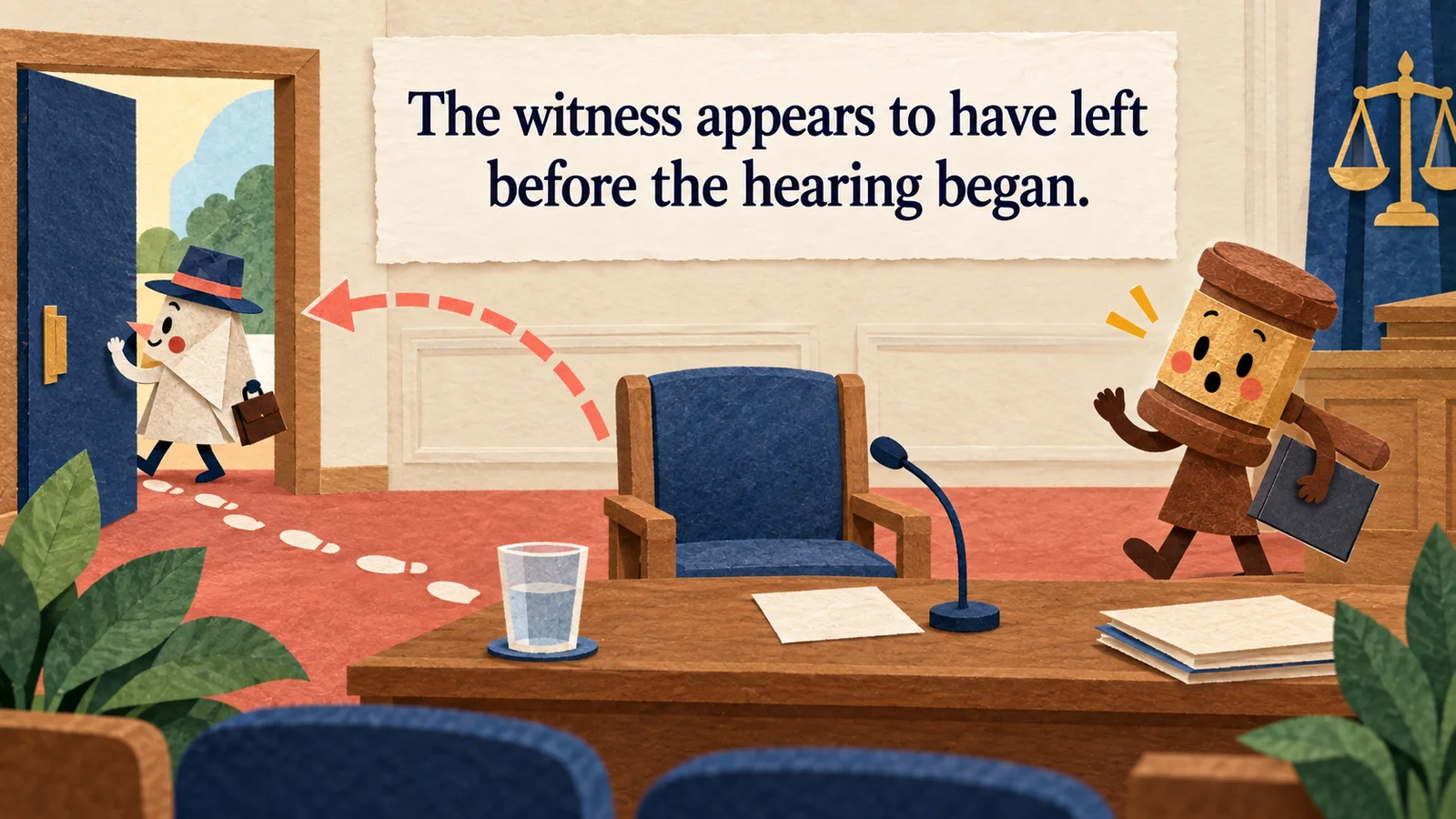
Perfect infinitive: to have done
The perfect infinitive is to have + past participle. Use it when an infinitive event is earlier than the point of reference:
The witness appears to have left before the hearing began.
The team is believed to have identified the source.
The main verb is present; the leaving and identifying happened earlier. Compare:
The witness appears to leave before the hearing begins.
This describes a repeated or typical sequence, not one completed earlier departure.
After a modal, the infinitive has no to:
The witness may have left.
The source must have been contaminated.
In these examples have + participle marks the earlier event; the modal expresses possibility or deduction.
Perfect -ing clause: having done
Use having + past participle when an -ing clause presents an earlier action:
Having checked the original recording, the editor withdrew the transcript.
The editor checked first and withdrew it later. Use the passive when the subject receives the action:
Having been warned about the conflict, the reviewers declared their interests.
The reviewers received the warning before declaring their interests.
The subject of a non-finite clause is often understood from the main clause. In the examples above, the editor checked and the reviewers were warned. Keep that relationship clear.
The verb pattern still matters
Perfect does not replace the complement pattern chosen by the verb:
She denied having seen the draft.
She claims to have seen the draft.
Deny normally takes an -ing form; claim commonly takes a to-infinitive. The perfect form places the seeing earlier, but it does not make every complement interchangeable.
Compare verbs where the choice changes the meaning:
He remembered to attach the schedule.
He remembered attaching the schedule.
The first means he did not forget to perform the action. The second means he has a memory of having done it.
Common mistakes
- She seems having misunderstood the point. Use seems to have misunderstood.
- He denied to have leaked the file. Use denied having leaked the file.
- Having been left early, the meeting was short. This attaches the earlier action to the meeting. Write Having left early, the chair kept the meeting short or name the correct subject.
- Do not add perfect have when the events are simultaneous: She seems to understand the issue, not to have understood, if the understanding is current.
Quick check
Which form puts the first event earlier?
- The analyst is thought ______ (discover) a flaw before publication.
- ______ (warn) of the delay, the team changed its schedule.
- The editor regrets ______ (approve) the wording.
Answers: to have discovered; Having been warned; having approved. For each item, identify who performed the earlier action before choosing active or passive form.
Build a non-finite clause around its time and subject
A non-finite verb does not show tense by itself. The main clause supplies the reference point; the non-finite form shows how its event relates to that point. The perfect form looks back from that reference:
The witness appears to have left before the hearing.
The present form appears gives the current assessment. The perfect infinitive to have left places the leaving earlier. Compare:
The witness appears to be leaving. — the departure is in progress or imminent
The witness appears to leave early. — a repeated or characteristic pattern
The witness appears to have left. — the departure happened earlier
The difference is not simply “present versus past”. It is a choice about the relation between two events.
Perfect infinitive and perfect -ing clause
Use to have + past participle after verbs and adjectives that license a to-infinitive:
The author is believed to have revised the conclusion.
The team seems to have overlooked one control.
Use having + past participle when the verb pattern calls for an -ing complement or when an earlier action provides background:
She denied having altered the figures.
Having checked the original recording, the editor corrected the transcript.
The perfect does not change the verb’s complement pattern. Deny normally takes an -ing form; seem normally takes a to-infinitive. Thus, denied to have altered and seems having overlooked do not follow the usual frames.
Make the understood subject explicit in your thinking
In a supplementary non-finite clause, the subject is often understood from the main clause:
Having checked the source, the editor corrected the quotation.
The editor checked and corrected it. If the subjects differ, name the subject or rewrite as a finite clause:
After the editor had checked the source, the quotation was corrected.
The original version, Having checked the source, the quotation was corrected, incorrectly suggests that the quotation checked the source. The perfect form cannot repair a mismatch between subjects.
Active and passive perfect forms
Use having done when the understood subject performed the action. Use having been done when that subject received it:
Having reviewed the contract, the lawyers raised two questions.
Having been reviewed twice, the contract was finally approved.
In the second sentence, the contract is the thing reviewed and approved. Passive participles make the receiver the subject, but the attachment still has to be logical.
Guided practice
- The current belief concerns an earlier discovery: The researchers are thought ___ (identify) the source.
- Complete with an -ing complement: The witness denied ___ (see) the draft.
- Correct the dangling clause: Having been warned about the delay, the delivery was rescheduled.
- Choose between to have worked and to work: The new version seems ___ better in the latest trial.
Answers and reasoning
- to have identified. The identification happened before the current belief.
- having seen or seeing, depending on whether you need to emphasize the prior event; denied seeing is the usual form.
- Having been warned about the delay, the client rescheduled the delivery or After the client had been warned, the delivery was rescheduled. The client receives the warning.
- to have worked if the trial has already taken place; to work if the version is being assessed as a current/general performer. The intended time relation decides.
Perfect does not automatically mean “long ago”
The perfect form expresses anteriority relative to a reference point. That point can be present, past or future:
The witness appears to have left. — earlier than the present assessment
The witness appeared to have left. — earlier than a past assessment
By noon, the witness was expected to have left. — earlier than a future or scheduled reference point
The form itself does not specify the calendar date. Context provides it. This is why a past-tense main verb can still take a perfect infinitive: The witness appeared to have left before dawn.
A perfect -ing clause can also follow a preposition:
After having reviewed the recording, the editor corrected the transcript.
Without having seen the original, the reviewers could not verify the quotation.
The perfect marks the review or seeing as earlier than the main event. When the sequence is obvious, English often uses the simpler -ing form after after: After reviewing the recording, the editor… Choose the perfect only when the earlier completion needs to be explicit.
The perfect infinitive can be active or passive: to have submitted the form means the subject submitted it; to have been submitted means the subject received the action. As always, ask whether the subject is the actor or receiver before building the form.
Further reading
Try this structure in a short practice set with instant feedback.
Start practice