Fronting and preposing
Fronting and preposing
Moving an element to the beginning of a clause can change its focus, but it does not always change the order of the subject and verb.
English clauses usually begin with the subject:
The committee rejected the second proposal.
A narrow path lay beyond the orchard.
We can sometimes move another element to the beginning of the clause to give it more prominence, connect it to what came before or create a particular effect. This is called fronting; some descriptions also use preposing.
The key point is that putting something first does not automatically require inversion. The word order depends on what has moved and what role it plays in the clause. Cambridge describes fronting as a way to focus objects, complements and adverbials, and shows that a fronted phrase does not always produce the same word order (Cambridge: “Fronting”; “Word order and focus”).
What you will learn
By the end of this lesson, you will be able to:
- recognise an object, complement or adverbial in front position;
- distinguish object fronting from subject–verb inversion;
- use locative inversion to introduce a person or thing in a place;
- identify when an opening phrase simply sets the scene; and
- keep fronting separate from inversion after negative or restrictive expressions.
The five patterns at a glance
| What comes first? | Example | What happens to the word order? |
|---|---|---|
| An object | The first proposal, the committee rejected. | The subject stays before the verb. |
| A subject complement | More worrying was the absence of an independent review. | Be comes before the full noun phrase subject. |
| A place phrase | Beyond the ridge lay a small settlement. | A position verb comes before the full noun phrase subject. |
| An ordinary time or manner phrase | After a short pause, the speaker continued. | The subject stays before the verb. |
| A negative or restrictive phrase | Only after the review did the board approve the report. | The auxiliary comes before the subject. |
Learn the first four as fronting choices. The final row is a related but separate inversion pattern: the negative or restrictive expression triggers subject–auxiliary inversion.
1. Fronting an object: keep the subject before the verb
An object normally follows its verb:
The committee rejected the first proposal immediately.
To make the object the topic or to contrast it with something else, we can put it first:
The first proposal, the committee rejected immediately.
The second proposal, it sent back for revision.
The fronted phrase is still the object. The clause after it keeps normal subject–verb order:
The first proposal, the committee rejected.
Object · subject · verb
Do not treat the fronted object as the subject. In the example above, the committee is still the subject: it performs the act of rejecting.
Object fronting works especially well when the object links to something already mentioned:
We considered three possible explanations. The first, the researchers ruled out straight away; the second, they investigated further.
It can also make a contrast sound deliberate:
This conclusion, I cannot accept.
This pattern is marked: it draws attention to the object before the listener or reader hears the comment about it. In polished prose, use it when the contrast or link is clear. If the sentence sounds strained, ordinary order is a good option:
I cannot accept this conclusion.
A related spoken pattern: the resumptive pronoun
In conversation, a speaker may put a topic first and then refer to it again with a pronoun:
That proposal, I can’t support it.
The pronoun it picks up the fronted topic. This is a related spoken pattern called left dislocation. In careful formal writing, choose either a fronted object without the extra pronoun—
That proposal, I can’t support.
—or the ordinary order:
I can’t support that proposal.
2. Fronting a subject complement: inversion with be
A subject complement gives information about the subject, often after be:
The absence of an independent review was more worrying.
For emphasis, the complement can come first. In this pattern, be comes before the full noun phrase subject:
More worrying was the absence of an independent review.
This order lets the sentence begin with the evaluation and place the subject later, where it receives more focus.
The verb agrees with the subject that follows it:
More worrying was the omission from the report.
More worrying were the omissions from the report.
This inversion is common in carefully shaped formal or literary prose. It is not a general rule that every adjective at the beginning of a sentence triggers inversion. The pattern here is specifically a fronted complement followed by be and a full noun phrase subject.
Compare the neutral and marked versions:
The final result was more surprising than the initial estimate.
More surprising than the initial estimate was the final result.
Both are grammatical. The second gives the comparison more prominence.
3. Fronting a place phrase: when the verb can come before the subject
A place phrase can introduce a setting:
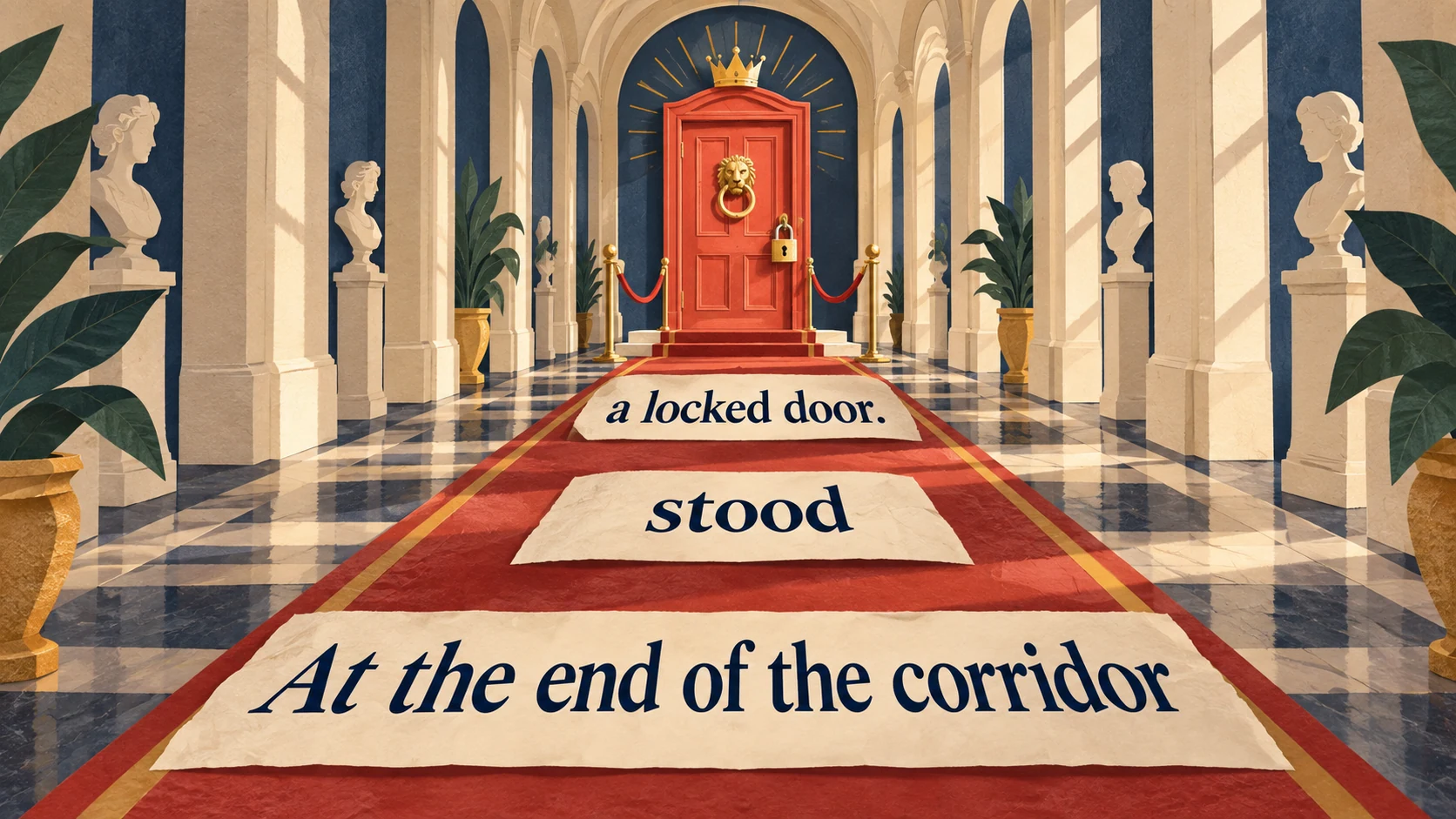
A locked door stood at the end of the corridor.
With some verbs that describe position, appearance or movement, a fronted place phrase can be followed directly by the verb and then the subject:
At the end of the corridor stood a locked door.
The common pattern is:
Place phrase + position/appearance verb + full noun phrase subject
For example:
On the lower shelf sat three reference books.
Beyond the final ridge lay a small settlement.
From the side entrance emerged two members of the review panel.
This order often introduces the subject as new information. Cambridge notes that a fronted prepositional phrase can occur with verb–subject order; the examples above show this locative pattern (Cambridge: “Fronting”). BBC Learning English also discusses inversion after place and movement phrases (BBC Learning English: “Inversion 2”).
Common verbs in this pattern include stand, sit, lie, remain, hang, appear, emerge and come. The verb agrees with the subject that follows:
At the entrance was a notice.
At the entrance were two notices.
With a pronoun subject, the usual order is subject before verb:
At the end of the corridor, it stood.
In ordinary prose, avoid the marked order At the end of the corridor stood it.
Not every place phrase requires locative inversion
The place phrase may simply set the scene, with the subject remaining before the verb:
In the west wing, the archive stores its most fragile documents.
Near the entrance, visitors can pick up a map.
Both sentences use the ordinary order: subject, then verb. The opening place phrase alone does not tell you to invert.
4. Fronting a time or manner phrase: usually keep ordinary order
Time and manner phrases can also appear at the beginning without inversion:
After a short pause, the speaker continued.
With unusual care, Mara lifted the document.
The following morning, the panel published its findings.
The subject still comes before the verb: the speaker continued, Mara lifted, the panel published.
Compare these two openings:
At the end of the corridor stood a locked door.
Place phrase + verb + subject.
After the meeting, the chair issued a statement.
Time phrase + subject + verb.
Ask what kind of phrase is at the beginning and what the rest of the clause is doing. Do not apply a single “first phrase means inversion” rule.
5. Keep fronting separate from negative inversion
Some expressions trigger subject–auxiliary inversion because they have a negative or restrictive meaning. This is the pattern from the inversion lesson, not the locative pattern above.
Rarely did the report mention the earlier trials.
Only after the review did the board approve the report.
Under no circumstances should the files be removed.
Here, an auxiliary comes before the subject: did the report, did the board, should the files. If the original sentence has no auxiliary, English uses do, does or did.
Compare the mechanisms:
This conclusion, we cannot accept.
The object is fronted; the subject we stays before the verb cannot accept.
Beyond the ridge lay a settlement.
A place phrase is fronted; the position verb lay comes before the full subject a settlement.
Only after the review did the board act.
A restrictive expression triggers subject–auxiliary inversion: did the board.
Cambridge’s overview of inversion explains the separate pattern after negative adverbials such as never and rarely (Cambridge: “Inversion”).
6. A quick way to decide the word order
When you see a phrase at the beginning of a statement, work through these questions:
-
Is it a negative or restrictive expression?
If so, use subject–auxiliary inversion:
Only then did the panel respond. -
Is it an object placed first for topic or contrast?
Keep the normal subject–verb order:
The final paragraph, the editor rewrote. -
Is it a subject complement placed before be?
In the marked pattern, put be before the full subject:
More serious was the omission. -
Is it a place phrase introducing a full noun phrase subject?
A position or appearance verb may come before the subject:
At the doorway stood two officers. -
Is it an ordinary time or manner phrase?
Usually keep the subject before the verb:
After the announcement, the audience applauded.
7. Common mistakes
Inverting after a fronted object
Not: This qualification, mentions the report.
This qualification, the report mentions.
The report is the subject and mentions is its verb.
Assuming every opening phrase triggers inversion
Not: After the second hearing, did the judge issue a statement.
After the second hearing, the judge issued a statement.
The time phrase sets the scene; it does not trigger inversion.
Using locative inversion with a pronoun subject
Awkward: On the bench sat it.
More natural: On the bench, it sat.
Adding do to locative inversion
Not: At the entrance did two officers stand.
At the entrance stood two officers.
The verb–subject order in locative inversion does not need do.
Forgetting subject–verb agreement
Not: Near the entrance was two notices.
Near the entrance were two notices.
The subject is two notices, so the verb is plural.
8. Guided practice
For each sentence, identify the opening phrase and choose the correct description:
- object fronting;
- complement fronting;
- locative inversion;
- ordinary fronted time or manner phrase; or
- negative/restrictive inversion.
- The final qualification, the report mentions only in a footnote.
- At the centre of the exhibition stood three large panels.
- Most surprising was the lack of disagreement.
- After a short break, the committee resumed the hearing.
- Only after the audit did the agency publish the full figures.
Now rewrite the sentences as instructed:
-
Put the object first for contrast:
I can accept the first recommendation, but I cannot accept the second. -
Put the place phrase first and use locative inversion:
A narrow path lay beyond the orchard. -
Put the complement first:
The final two omissions were more serious than the incorrect reference.
Answers and reasoning
- Object fronting. The subject the report stays before mentions.
- Locative inversion. The place phrase is followed by stood and then the full noun phrase subject three large panels.
- Complement fronting. The subject complement most surprising comes before was; the subject the lack of disagreement follows it.
- Ordinary fronted time phrase. The subject the committee stays before the verb resumed.
- Negative/restrictive inversion. Only after triggers did + subject + base verb.
- The first recommendation, I can accept; the second, I cannot. The objects are fronted for contrast; neither clause needs object-fronting inversion.
- Beyond the orchard lay a narrow path. The fronted place phrase is followed by the position verb and the full subject.
- More serious than the incorrect reference were the final two omissions. The fronted complement comes first, and were agrees with the plural subject the final two omissions.
Further reading
- Cambridge Dictionary: “Fronting” — examples of fronted objects, complements, adverbials and place phrases.
- Cambridge Dictionary: “Word order and focus” — how changing clause order shifts focus.
- Cambridge Dictionary: “Inversion” — subject–auxiliary inversion after negative expressions.
- BBC Learning English: “Inversion 2” — examples of inversion after place and movement phrases.
Try this structure in a short practice set with instant feedback.
Start practice