Ellipsis in comparative clauses
Comparative clauses often leave out words because the reader can recover them from the first half. That economy is helpful only when the missing material is obvious. When the comparison is hard to reconstruct, keep an auxiliary or rewrite the sentence.
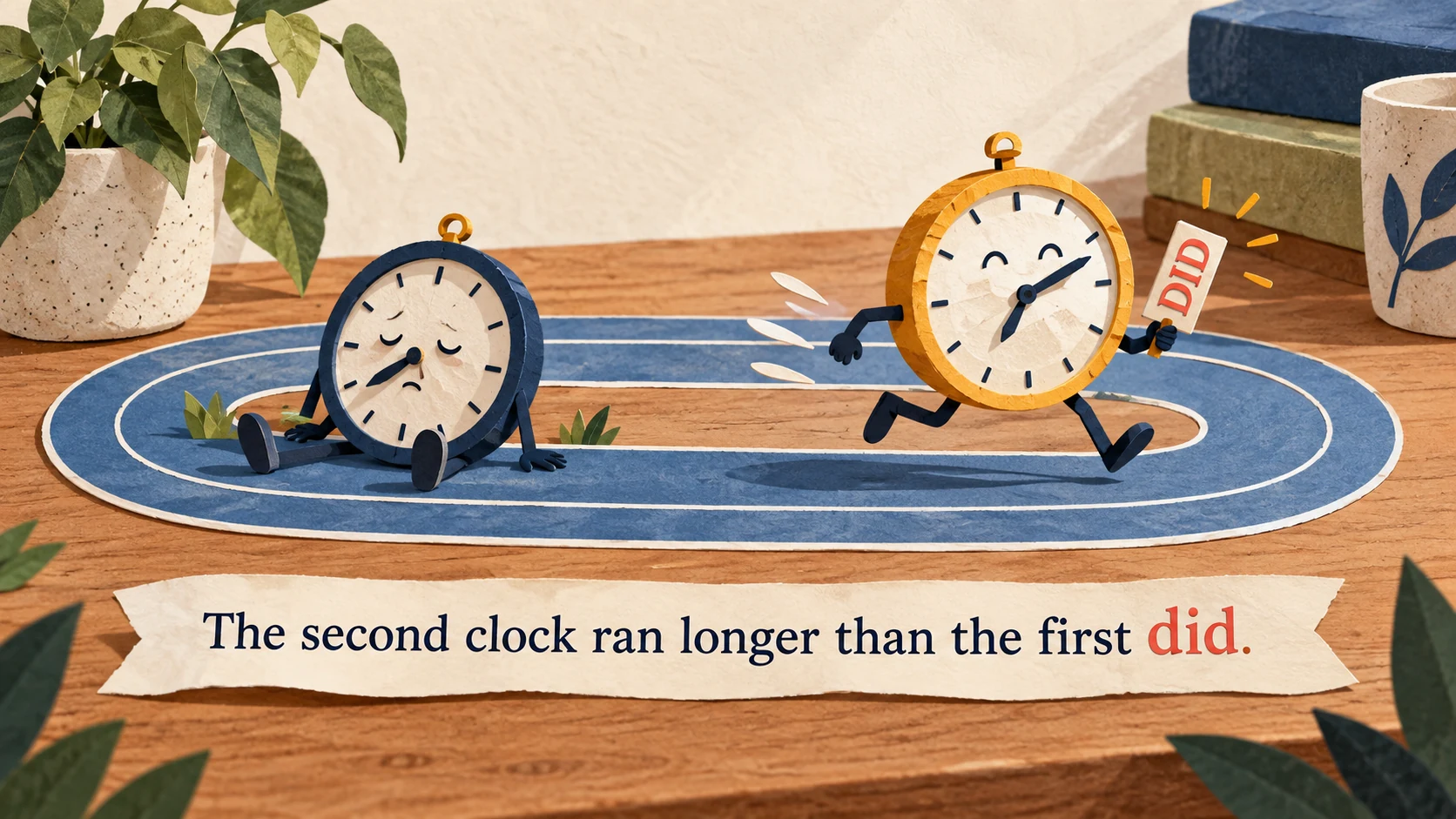
What can disappear after than?
Compare the full clause with the reduced one:
The second analysis took longer than the first analysis took.
The second analysis took longer than the first did.
The second analysis took longer than the first.
The repeated verb phrase is recoverable, so it can be omitted. In the middle version, did makes the comparison explicit. In the final version, the reader infers “the first analysis took”.
After than, English allows both an object pronoun and a subject pronoun with a verb:
The revised model performed better than me.
The revised model performed better than I did.
The first treats than me as a comparison with a person; the second makes the understood verb explicit. In formal writing, than I did is often clearer, especially when the two clauses have different subjects or time references. Do not call every than + object pronoun incorrect; choose the form that expresses the intended comparison.
Keep an auxiliary when it carries information
If the first clause contains an auxiliary, the comparison may need the same auxiliary or an appropriate substitute:
The committee has revised more drafts than we have.
The committee can process cases more quickly than it could last year.
The auxiliary prevents repetition while preserving tense or modality. Do not omit it if doing so would make the time or meaning unclear.
Comparisons with as
The same principle applies after as:
The final version was not as concise as we had hoped.
The final version was not as concise as the earlier one.
In the first example, had hoped completes the comparison. In the second, one replaces a noun phrase. They do different jobs: one stands for a clause, the other for a countable thing.
Expressions such as than expected and as planned are compact participle clauses. They are natural when the implied experiencer or planner is easy to infer:
The launch was delayed longer than expected.
If the source of the expectation matters, spell it out: longer than the engineers had expected.
Do not compare unlike things
A comparison needs two parallel ideas:
The response time of the new model was shorter than that of the old model.
That of replaces response time. Without it, The response time was shorter than the old model compares a duration with a model.
Common mistakes
- She understood more than I. This can sound incomplete in careful prose. Use more than I did when the action should be explicit.
- The report was clearer as expected. Use than expected for a comparison.
- The second version is more concise than the first version is. This is grammatical but repetitive. Use than the first or than the first is if the verb contrast matters.
- The rate of approval is higher than the earlier survey. Compare the rate ... with the rate in the earlier survey.
Quick check
Choose the clearest completion.
- The revised draft is shorter than ______.
- We received fewer objections than we ______.
- The outcome was not as predictable as ______.
Possible answers: the original; had expected / anticipated; we had assumed. Each keeps the comparison recoverable without repeating the whole clause.
Decide what the comparison leaves out
Ellipsis is not random deletion. The missing words must be recoverable from the first part of the comparison, and the reader must be able to tell which parts are shared. Use this three-step check:
- Find the thing being compared. Is it a person, amount, action, result or quality?
- Reconstruct the full clause silently. What words would follow than or as if nothing were omitted?
- Keep enough grammar to show tense, voice or modality. An auxiliary often carries exactly that information.
The second team completed more trials than the first did.
The second team completed more trials than the first.
Both are clear because completed trials is easy to recover. If the clauses differ in tense, keep the auxiliary that makes the difference visible:
The new system processes requests faster than it did last year.
Removing did would leave the comparison less explicit and could make the time reference harder to interpret.
Pronoun or clause?
After than and as, an object pronoun may be used when the comparison is straightforward:
The proposal affects the analysts more than me.
But the reader can also understand a clause with its subject pronoun:
The proposal affects the analysts more than it affects me.
Sometimes these versions mean different things. The first compares how much the proposal affects the analysts with how much it affects me. The second may compare its effect on analysts with the action of affecting me, though context normally resolves this. When ambiguity matters, write the fuller clause: more than it affects me or more than it affects the reviewers.
The formal form than I / than she can be grammatical when it represents a clause with an omitted verb, but in modern edited prose a short auxiliary often makes the intended structure easier to read: than I did, than she does.
Substitution is not the same as ellipsis
Compare:
We received more applications than we expected.
We received more applications than the previous year.
In the first, expected is the verb of a reduced clause. In the second, the phrase can mean “than [we received] the previous year”; the verb is understood. If the second version might be read as comparing applications with a year, add a substitute:
We received more applications than we did the previous year.
Likewise, use that / those to stand for a noun phrase, not a clause:
The error rate was lower than that recorded in the pilot.
Here that means the error rate. The participle recorded in the pilot identifies which one. Use than expected when the comparison is with an expectation, not a thing.
Guided practice
- Keep the past-time contrast clear: The current model uses less power than it ___ five years ago.
- Remove unnecessary repetition: She interpreted the results more cautiously than the previous analyst interpreted them.
- Repair the comparison: The demand for this service is greater than last year.
- Explain what those replaces: The revised estimates were more conservative than those submitted in April.
Answers and reasoning
- did. The auxiliary keeps the past reference explicit.
- She interpreted the results more cautiously than the previous analyst did. The action is recoverable.
- Demand for this service is greater than it was last year, or The demand this year is greater than last year’s. The original compares demand with a year.
- Estimates. Those submitted in April means the estimates that were submitted then.
Let grammar and context share the work
Comparative ellipsis is most successful when the two sides are parallel and the omitted words are predictable:
The revised report is shorter than the original (report).
The revised report is shorter than the original was.
The first comparison is between two reports; the noun is understood. The second compares a property of the report at two times; was preserves the past time reference. If the reader has to invent a different missing subject, restore the words.
Degree words such as much, far, a great deal, slightly and considerably can make a comparison more precise:
The revised method is far less expensive than the original was.
The second sample is slightly larger than the first.
Do not use very directly with a comparative in standard edited English: use much better, far more reliable, or significantly less likely.
Comparisons can also contain a hidden object or quantity. Ask whether the adjective describes the same dimension on both sides:
The new protocol is more demanding than the old one.
This may mean that the protocol requires more effort. If a different dimension is intended, state it: The new protocol is more demanding of reviewers than the old one was. Precision can require a few extra words.
Further reading
Try this structure in a short practice set with instant feedback.
Start practice