Noun and adjective preposition patterns
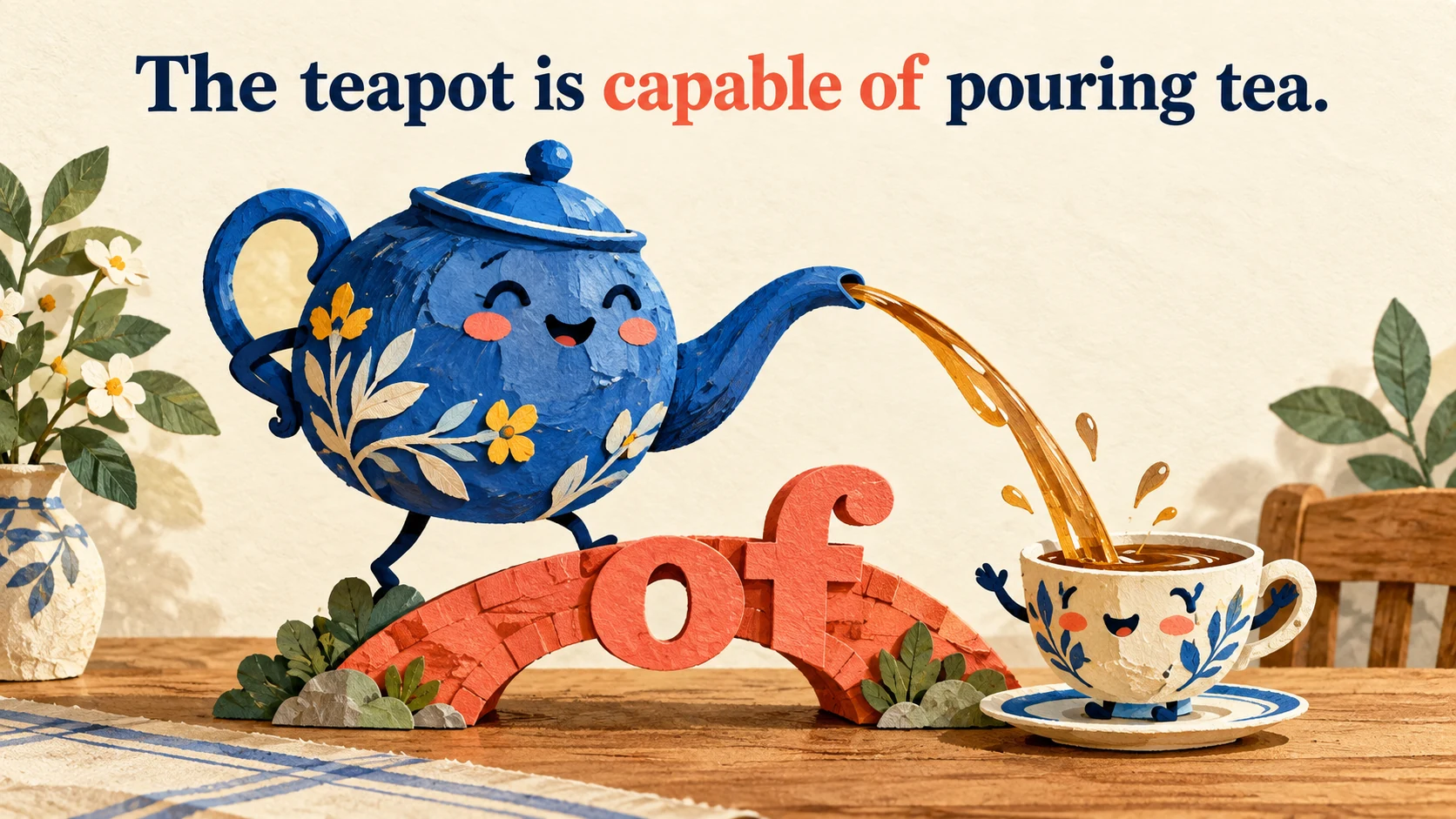
English often links a noun or adjective to the next idea with a particular preposition: interest in, reason for, proud of. The preposition may not match the one used in a related phrase in your first language. It is more reliable to learn the whole combination than to guess.
Common adjective patterns
interested in learning a new language
proud of her progress
responsible for organising the event
similar to the original design
aware of the risks
good at solving puzzles
worried about the delay
keen on working outdoors
After a preposition, use a noun, pronoun or -ing form: interested in music, proud of them, responsible for organising. Do not use a bare infinitive after the preposition: interested in learn.
Some adjectives allow more than one preposition, but the meaning changes:
She is angry with Leo (the person).
She is angry about the decision (the situation).
Walking is good for your health (it benefits your health).
She is good at climbing (she has skill in that activity).
Similar adjectives may need different prepositions
The meaning of an adjective does not reliably predict its preposition. Compare interested in music, keen on music and enthusiastic about music. All express interest, but their patterns differ.
Use a compact record that includes the complement:
| Adjective + preposition | Meaning in this phrase | Example |
|---|---|---|
| capable of | Having the ability | She's capable of leading the team. |
| satisfied with | Happy with a result | We're satisfied with the service. |
| dependent on | Needing or relying on | The project is dependent on funding. |
| suitable for | Appropriate for a purpose | This route is suitable for beginners. |
| different from | Not the same as | The result is different from our prediction. |
| afraid of | Feeling fear | He's afraid of flying. |
Different to is also common in British usage, and different than occurs especially in American usage. Different from is a useful broadly accepted choice for learners.
One adjective, two relationships
Good at describes skill: She's good at explaining ideas. Good for describes benefit or suitability: Walking is good for your health. Good to can describe kind behaviour: They were very good to us.
The same adjective appears in each, but the preposition helps define the relationship. Compare angry with someone and angry about something. Angry at is also possible with a person or cause. These are common combinations, not rigid categories with no overlap.
When revising an incorrect phrase, replace the complete pattern rather than guessing a new preposition from its translation: good in explain becomes good at explaining. Both the preposition and the following verb form need attention.
Nouns and their usual prepositions
Nouns have their own patterns, which may differ from the related verb:
an increase in prices
a solution to the problem
a reason for the delay
an invitation to the event
a response to the complaint
a difference between the two plans
Compare They responded to the complaint with their response to the complaint; the preposition stays the same. But They analysed the data becomes an analysis of the data. You cannot always predict the noun pattern from the verb.
To is not always an infinitive marker
In look forward to meeting you, to is a preposition, so the next verb takes -ing. The same is true in object to changing the date, be used to getting up early and committed to improving access. Compare want to meet you, where to meet is an infinitive.
This distinction also explains why I’m used to working late means late work is familiar, while I used to work late describes a past habit. The words look similar, but the grammar and meaning differ.
Build a useful vocabulary record
When you learn a new adjective or noun, write a short example with its preposition and complement: capable of managing a team, a shortage of staff, a complaint about the service. Include the form that follows the preposition. Review the whole phrase rather than memorising a bare translation.
If you are unsure, check a learner’s dictionary entry for the word and its examples. Cambridge has dedicated pages for nouns and prepositions and word patterns such as interested in.
Keep the roles clear in longer noun patterns
A noun can introduce two different participants:
an invitation to the exhibition from the organiser
a complaint about the noise from a neighbour
To identifies the event you are invited to; from identifies the inviter. About identifies the subject of a complaint; from identifies its source. Keeping the roles separate makes longer phrases easier to understand.
An increase in prices identifies what changed. An increase of ten per cent measures how much it changed. Together: There was an increase of ten per cent in ticket prices. A different preposition can add different information rather than compete for the same position.
Consider a practical message:
Thank you for your invitation to the workshop. I'm interested in attending, but I'm worried about missing the final session. Is there a solution to this problem?
The patterns connect ideas smoothly. Notice interested in attending: after the preposition, attending is required. A pronoun would also fit: interested in it.
For to, try replacing the following action with a noun: look forward to the visit → look forward to visiting. This reveals a preposition. Want to visit, by contrast, is an infinitive pattern; you cannot say want to the visit.
You can use dictionaries to check the pattern and make one personally relevant example. Reviewing responsible for updating the calendar as a unit is more helpful than memorising responsible = responsable and choosing the preposition later.
Sources and further reading
Try this structure in a short practice set with instant feedback.
Start practice