Narrative tense contrasts
A clear story needs more than a list of past verbs. The writer chooses which events move the story forward, which actions form the background and which events happened earlier still. English commonly uses the past simple, past continuous, past perfect and past perfect continuous for these different jobs.
I was walking home when I saw a dog I had met before.
The walk is the background in progress; seeing the dog is the main event; meeting it happened before both. Each verb places the reader at a different point in the scene.
Four tenses, four jobs in a story
Before choosing a tense, decide what the sentence is doing. Is it moving the action forward, describing the surroundings, explaining an earlier event, or showing earlier activity?
| Job | Tense | Example |
|---|---|---|
| Main event | Past simple | A cyclist stopped beside us. |
| Activity around that event | Past continuous | We were looking at the map. |
| Earlier completed event | Past perfect | We had taken the wrong turning. |
| Earlier activity or duration | Past perfect continuous | We had been walking for an hour. |
Think of the past simple as the sequence of events a reader follows. The other tenses supply information around that sequence. You can tell a clear story mostly in the past simple; use the other forms when they add a useful time relationship.
Compare I read the message and went outside with I was reading the message when someone knocked. In the first, reading is one completed event in a sequence. In the second, reading is the activity already happening when a new event interrupts it. Neither choice depends on whether reading lasted two minutes or two hours.
The past simple moves the story
Use the past simple for completed events that advance the sequence:
Mara opened the gate, crossed the garden and knocked on the door.
The natural reading is that one action followed another. A story usually relies on the past simple for its main line: The lights went out. Someone shouted. We found a torch.
The past continuous sets the scene
Use was/were + -ing for an activity in progress around a particular past moment:
The rain was falling, and people were hurrying towards the station.
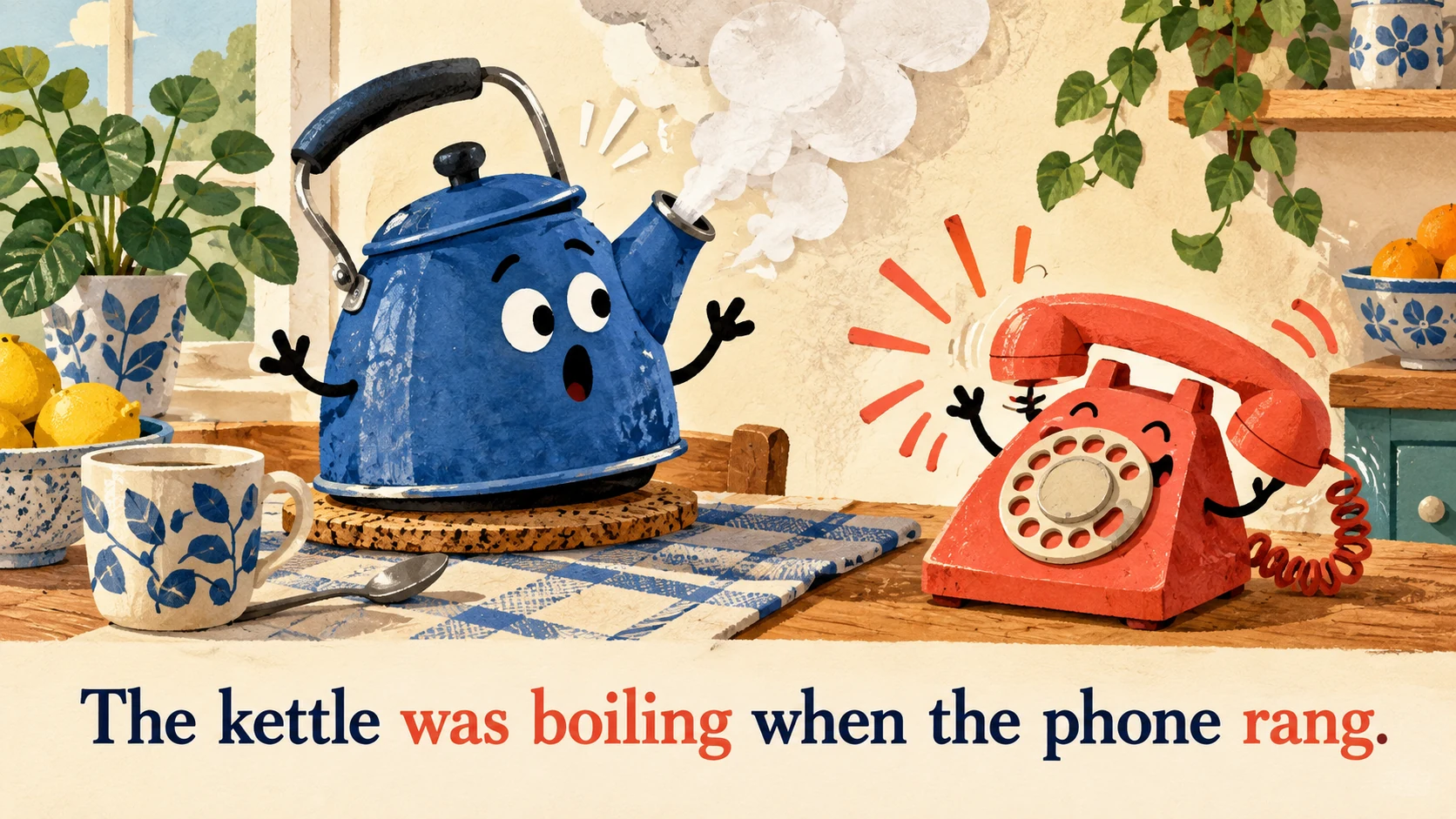
I was cooking when the phone rang.
In the second example, cooking was already in progress; the ring is a shorter event that interrupts it. A continuous action does not have to be interrupted, though: At midnight, the team was still checking the figures.
Two continuous forms can describe simultaneous background actions: While I was setting the table, Leo was preparing the food. Use while when the overlap matters. The past simple is also possible if the actions are presented as complete events rather than as a scene.
Looking further back
The past perfect marks an event earlier than the past moment established by the story:
We reached the cinema, but the film had already started.
She recognised the street because she had lived there as a child.
Do not put every sentence into past perfect after the first one. Once the earlier time frame is clear, return to past simple for the next event in the main sequence: I realised someone had moved the files. I checked the cabinet and called my colleague.
Use past perfect continuous when the duration or activity itself matters: He had been waiting for an hour when the doors opened. Compare She had written three emails before lunch (completed number) with She had been writing emails all morning (process and duration).
When, while and as
When often introduces the shorter event, but it can also introduce a longer period: When I lived in Madrid, I travelled by bike. While usually highlights an activity in progress or two simultaneous events: While the guests were talking, the host prepared dinner. As can link events that develop together: As the sun was setting, the temperature dropped. The choice helps the reader see how the scenes overlap; it does not mechanically decide the tense.
A common error is to use continuous forms for every action simply because the story feels vivid. She was opening the box, was taking out the letter and was reading it sounds awkward if those are successive completed actions. She opened the box, took out the letter and read it moves the story forward more naturally.
A short scene, with the choices explained
The café was almost empty. I had been waiting for twenty minutes, and the rain was tapping against the window. Then the door opened. A woman I had seen on the train stepped inside and looked around.
Was and was tapping establish the setting. Had been waiting gives the duration leading up to the scene. Opened is the new event. Had seen explains that the earlier meeting happened before the woman entered. Once you can describe what each verb contributes, tense choices become easier than memorising a long list of rules.
Cambridge’s guides to past simple and past continuous explain the main contrast; the past perfect pages show how to add an earlier time layer.
How to revise a confusing sequence
Here is a draft that leaves the order unclear:
I reached the campsite. My friends cooked dinner. I lost my phone. I searched for it for an hour.
Did the friends cook after the arrival? Was the phone lost at the campsite? The sentences do not establish those relationships. First decide the facts: the phone was lost earlier; the search took place before the arrival; dinner was in progress when the speaker arrived. Then revise:
When I reached the campsite, my friends were cooking dinner. I was upset because I had lost my phone. I had been searching for it for an hour. Then I borrowed Ana's phone and called my number.
Reached, borrowed and called are the main events. Were cooking places dinner in the background. Had lost explains the problem; had been searching explains the preceding effort.
You do not need to start a new past perfect chain every time you return to an earlier scene. Establish the earlier viewpoint clearly, then let the context help the reader follow a longer flashback. In short B2 narratives, an explicit phrase such as earlier that morning is often enough to support the tense choices.
Two mistakes that change the picture
While often introduces activity, but it does not mechanically require the continuous. While I was waiting, I checked my messages focuses on an ongoing wait. While I lived in Rome, I learned Italian describes a period of residence. Choose the meaning before applying a pattern.
Also, when does not always mean “an interruption”. When I finished the email, I sent it is a sequence of completed events. When I had finished the email, I sent it puts extra emphasis on finishing first.
To plan your own story, write the actual event order in a short line first: lost phone → searched → reached camp → borrowed phone. Then decide which point the story opens with. This gives you a reason for every change of tense.
Sources and further reading
Try this structure in a short practice set with instant feedback.
Start practice