Mixed conditionals
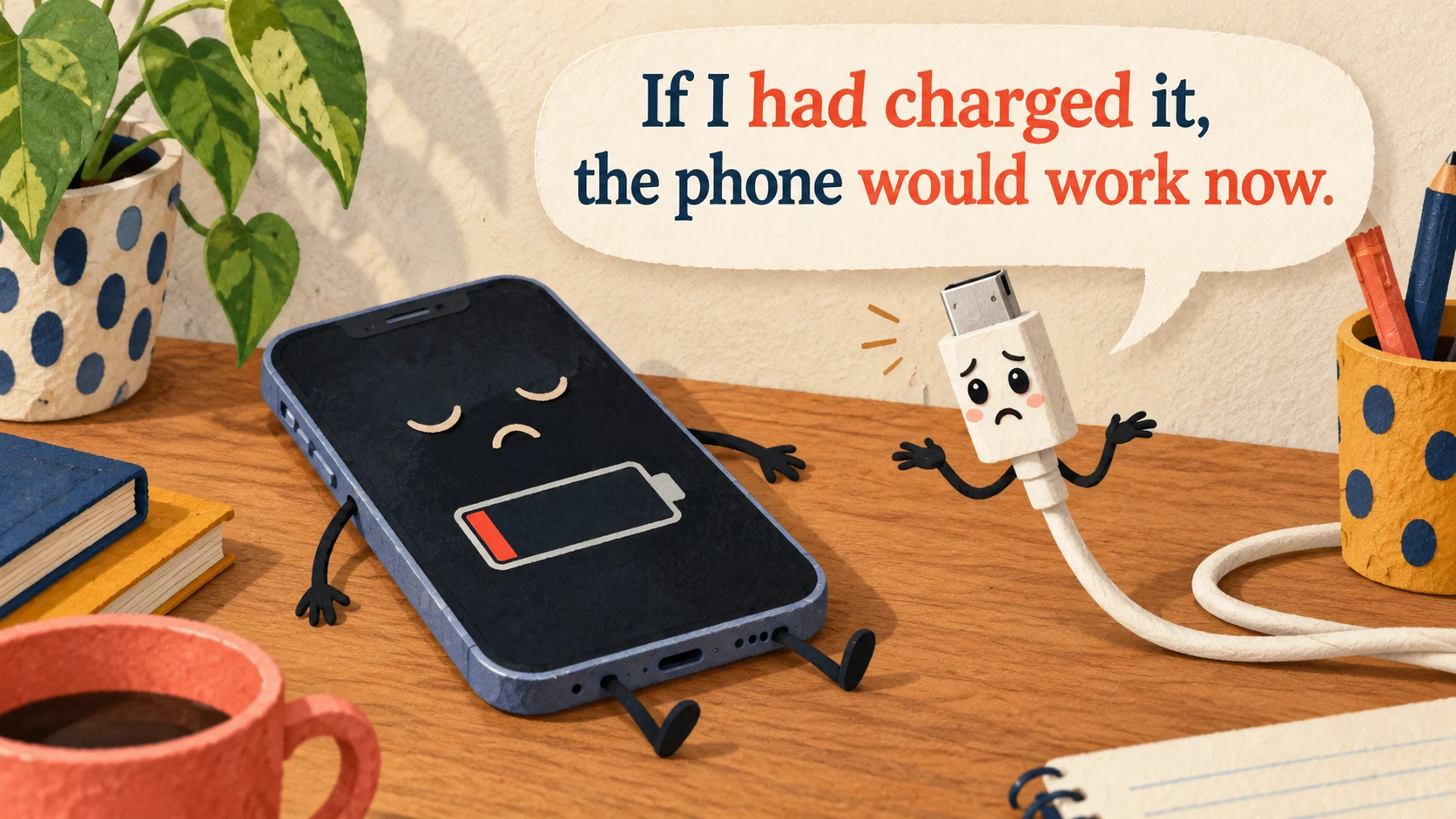
Most textbook conditionals keep the condition and result in the same time frame. A mixed conditional connects different time periods—for example, a past decision with a consequence that is still true now.
If I had taken the job, I would live in Berlin now.
I did not take the job; as a result, I do not live in Berlin now. The condition is an unreal past (if + past perfect), while the result is an unreal present (would + infinitive).
Give each clause its own time label
A useful mistake to avoid is choosing the result tense just because you have already chosen the condition tense. Instead, attach a time label to each idea.
| Imagined condition | Imagined result | Structure |
|---|---|---|
| A different decision yesterday | A different situation now | If + had + participle → would + base verb |
| A different quality in general | A different event yesterday | If + past form → would have + participle |
Read If I had charged my phone last night, it would work now. Had charged belongs to last night. Would work belongs to now. Adding have worked would move the imagined working into the past, which is not the intended meaning.
A timeline makes this visible:
Past: I didn't charge it → present: it doesn't work
Alternative past: I had charged it → alternative present: it would work
This is one connected cause-and-effect relationship across two times. You are not mixing verb forms simply to make a sentence more advanced.
Past condition, present result
This is the most common mixed pattern:
If we had booked a table, we wouldn’t be waiting outside now.
If Lena had studied medicine, she would be a doctor today.
If I had gone to bed earlier, I wouldn’t feel so tired now.
The past event created a continuing present situation. Words such as now, today, still and at the moment make the timeline easy to see, but context can be enough.
The result modal can change the meaning: would be presents the imagined outcome; could be highlights ability or possibility; might be signals uncertainty. If I had kept the receipt, I could get a refund now means the receipt would make a refund possible, not certain.
Present condition, past result
We can also imagine that a present quality or situation affected something in the past:
If I were more organised, I wouldn’t have missed the appointment.
If she spoke French, she could have helped us yesterday.
The if-clause describes a current or general fact that is unreal; the result refers to an earlier event. In the first example, I am not organised enough now, and that trait is presented as the reason for my past mistake.
For formal or hypothetical situations, were is common with all subjects: If he were less cautious, he might have accepted the offer. In informal speech, was is also common with I/he/she.
How this differs from the third conditional
Compare:
If I had taken the job, I would have moved to Berlin.
Both condition and result refer to the past: I did not take it and did not move.
If I had taken the job, I would be living in Berlin now.
Past condition, present result: I did not take it and do not live there now.
A mixed conditional is not just two random tenses in one sentence. The time relationship must make sense. If the result is also entirely in the past, the third conditional is usually the more natural choice. If the condition describes a real possibility for the future, use a first conditional: If I get the job, I’ll move to Berlin.
A simple way to build one
First write what is true now and what happened in the past. Then imagine a different cause and connect it to the appropriate result:
- Reality: I did not save the number; I cannot call her now.
- Alternative: If I had saved her number, I could call her now.
Or reverse the timeline:
- Reality: I am not confident speaking French; I did not apply for the role.
- Alternative: If I were more confident in French, I might have applied for the role.
Cambridge groups mixed forms with other conditionals and wishes, and its guide to if-clauses helps distinguish real and unreal time references.
Three outcomes from the same past decision
Imagine that you did not buy a ticket for a training course. Now choose exactly what consequence you want to describe:
If I'd bought a ticket, I would have attended the course last week.
If I'd bought a ticket, I would be attending the final session now.
If I'd bought a ticket, I would be able to use the recordings tomorrow.
The first is a third conditional: past condition and past result. The second connects the past decision to an activity now, using would be + -ing. The third connects it to future access, using would be able to. The label “mixed” is less important than making each time relationship clear.
A present quality must also be relevant to the past
If I spoke Japanese, I could have translated the email yesterday treats speaking Japanese as a general ability that would have been available yesterday. It does not suggest that learning Japanese today could change yesterday's event.
Compare If I had learned Japanese before that trip, I could have translated the email. Here the condition itself is explicitly a past learning event. Both sentences are possible, but they describe the cause differently.
A misleading sentence would be If I were in Paris right now, I would have met you there yesterday, unless the context explains how today's location reflects being there yesterday too. When the time link is unclear, state the intended past condition directly: If I had been in Paris yesterday, I would have met you.
To choose between forms, finish this thought in ordinary language first: “Because this happened then, this is true now” or “Because this quality is generally true, that happened then.” If the link makes sense, build the corresponding conditional. The British Council's comparison of third and mixed conditionals offers more examples of both relationships.
Sources and further reading
Try this structure in a short practice set with instant feedback.
Start practice