Past continuous
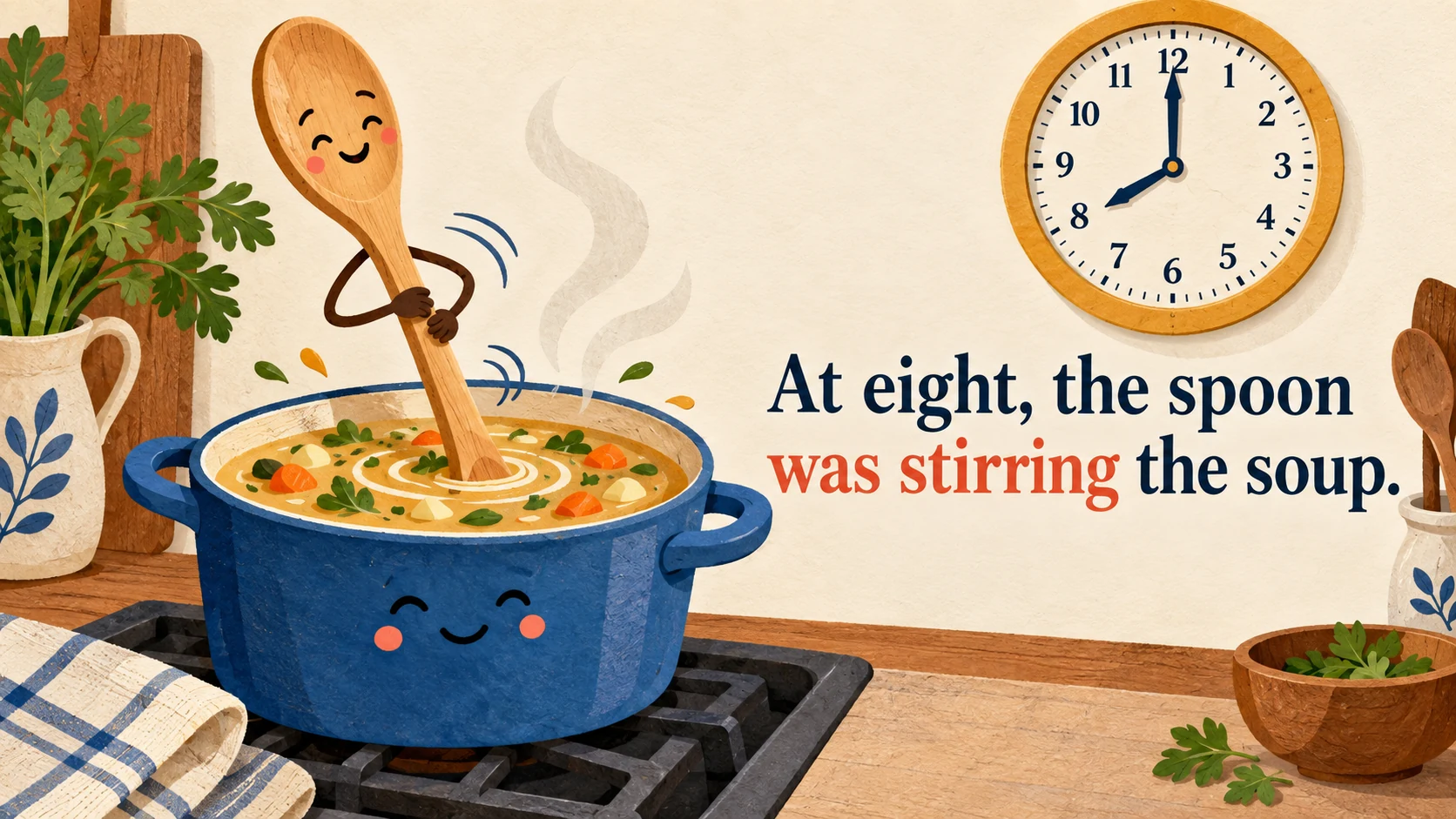
At eight o’clock, the kitchen light was on and Leo was making dinner. The past continuous lets us look inside an activity at a past moment.
Form
Use was/were + verb-ing.
- I was reading.
- They were playing outside.
- She wasn’t listening.
- Were you studying at nine?
Choose was with I, he, she, it and were with you, we, they.
Imagine a photograph of a past moment
A photograph taken at eight might show someone cooking. At eight, Leo was cooking describes the activity visible at that moment. It does not tell us when he started, when he finished or what happened afterwards.
7:30 — cooking begins → 8:00 — our viewpoint → 8:30 — cooking ends
The past continuous places us at eight, inside the activity. Leo cooked dinner yesterday instead reports the event as a whole.
Questions and negatives use be
| Subject | Statement | Negative | Question |
|---|---|---|---|
| I/he/she/it | She was working. | She wasn't working. | Was she working? |
| you/we/they | They were working. | They weren't working. | Were they working? |
The word you takes were, even when you mean one person: Were you waiting outside?
Do not add did: Did she was working? should be Was she working? The short answers are Yes, she was and No, she wasn't. A question word comes first: Where were they working?
The -ing part does not change for different subjects. Choose the right was/were, then keep working.
What does it show?
The past continuous describes an activity in progress at a particular past time: At 7 p.m., we were having dinner. It does not tell us when dinner began or ended.
It also sets a scene: The sun was shining and people were sitting outside. The writer describes what was happening around the main events.
A shorter action can happen during the longer activity: I was cooking when the phone rang. The cooking was already in progress; the ringing happened at that point. The next lesson looks closely at this contrast.
Compare the meaning
- At eight, I was watching a film. You see the activity in progress at eight.
- I watched a film last night. You report a completed past event.
A past continuous sentence does not always mean that the activity was never completed. It simply focuses on a time during the activity.
Describe a scene, then introduce an event
The café was busy. A waiter was carrying drinks, two children were drawing, and a woman was reading by the window. Suddenly, someone dropped a glass.
The continuous forms describe the scene already in progress. Dropped introduces a new completed event. The story does not say all the other activities stopped when the glass fell.
An event happening during another activity is not always an interruption that ends it. I was listening to music when you texted does not imply I stopped listening. It only places the text inside the listening period.
Two activities can share a period: While I was studying, my flatmate was cooking. Both were in progress; neither needs to be presented as the main event.
Duration is not the deciding factor
I lived in Madrid for ten years describes a long period, but the past simple is natural when you present it as complete. I was opening my bag when the ticket fell out describes a much shorter activity from inside it. The continuous does not simply mean “long”.
Some state verbs normally stay simple: I knew the answer, rather than I was knowing the answer. I was thinking about the answer is an activity, so the continuous is natural.
To describe your evening yesterday, first choose a specific viewpoint: At nine ... Then name two activities in progress: I was reading, and my brother was playing a game. Finally, add a completed event with the past simple: Then the power went out. This gives each form a clear job.
Sources and further reading
Try this structure in a short practice set with instant feedback.
Start practice