First conditional
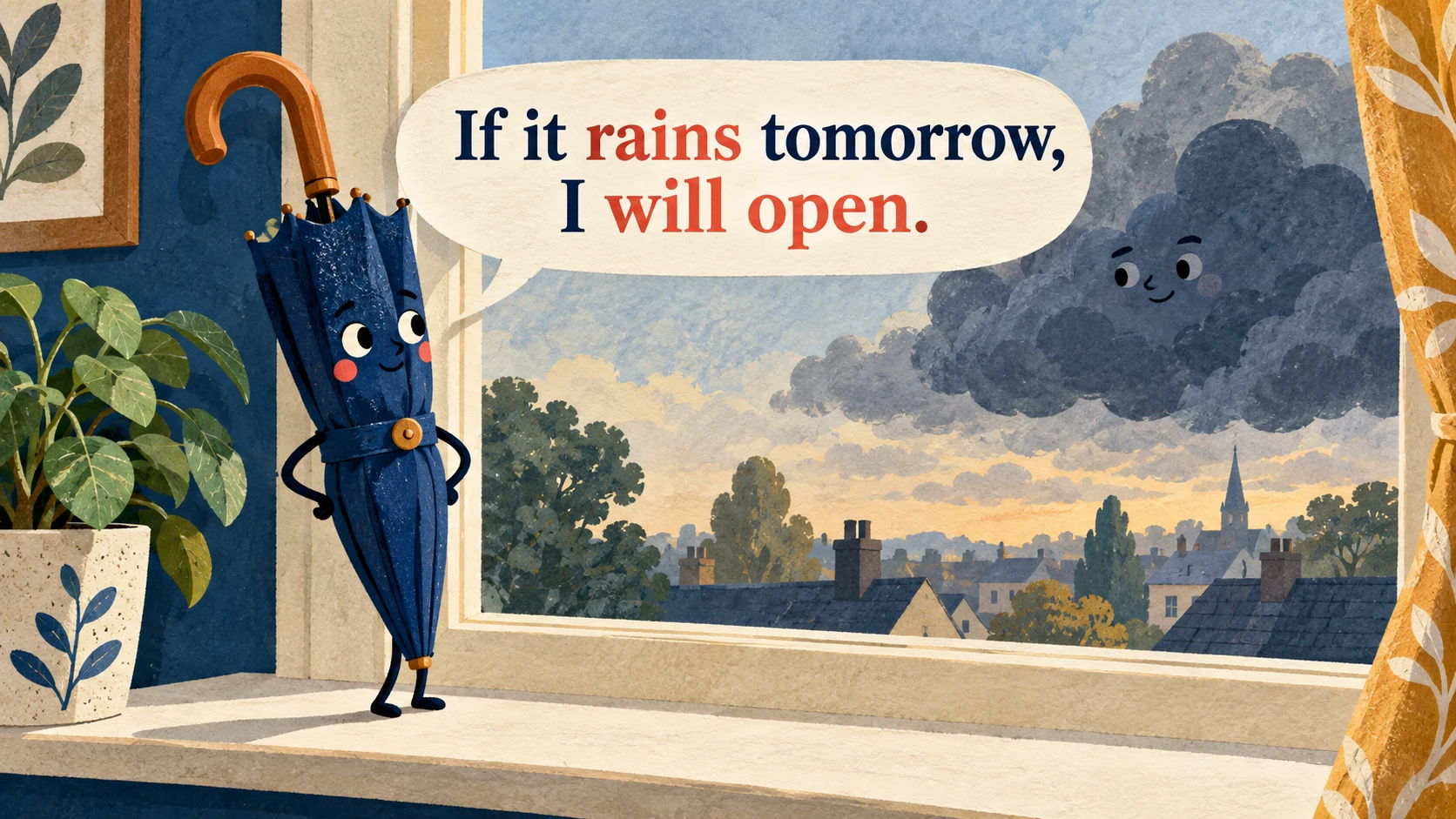
“If the train is late, I’ll call you.” The train might be late; the speaker explains what will happen in that case.
Form and meaning
Use if + present simple, will + base verb to talk about a possible future condition and its likely result:
- If it rains tomorrow, we’ll stay indoors.
- If you study tonight, you’ll feel more prepared.
The if-clause describes a condition, not a future fact. That is why we normally use the present simple there, even when the meaning is future: If she arrives early, not If she will arrive early.
The present form can refer to a future condition
Imagine planning a picnic for Saturday. You do not know Saturday's weather yet:
Possible condition on Saturday: it rains → planned response: we stay at home
The sentence is If it rains on Saturday, we'll stay at home. Rains is a present form, but the date makes its future meaning clear. English normally uses a present form in this kind of future condition.
The conditional does not promise that it will rain. It explains the result in that case. If the condition does not happen, the sentence alone does not tell us what you will do.
Keep the two verb patterns separate
| Clause | Positive | Negative |
|---|---|---|
| Condition | if she comes | if she doesn't come |
| Result | we'll start | we won't start |
For questions, use question order in the main clause: Will you call me if you're late? The condition keeps ordinary statement order: if you're late, not if are you late.
After will/won't, use the base verb: will arrive, not will arrives or will arrived. With be, say will be ready.
The third-person -s belongs in the present condition: If he finishes early, he'll help us. It does not belong after will.
Change the order
Both orders are possible:
- If I finish work early, I’ll meet you.
- I’ll meet you if I finish work early.
The meaning is the same. Put a comma after an opening if-clause; do not usually put one before a final if-clause.
The result can vary
The result does not always need will. It can be a command, a suggestion or another modal:
- If you see Marta, tell her I called.
- If it rains, we can take a taxi.
At B1, start with the common if + present, will + verb pattern, then notice these natural variations.
Compare with the zero conditional
- If I’m tired, I go to bed early. This is a habit.
- If I’m tired tonight, I’ll go to bed early. This concerns tonight.
Look for the time frame and the intended meaning, not only the word if.
The result tells us how certain or practical the response is
Will presents a prediction or commitment: If you send the file today, I'll read it tonight. Other choices let you express a different result:
If the weather improves, we might eat outside. — a possibility
If you finish early, you can join us. — an available option or permission
If you feel unwell, you should rest. — advice
If you need help, call me. — an instruction or invitation
The first conditional is not limited to a single formula. The formula helps you begin; the result form expresses the message you need.
Plan a conversation
A: What will we do if the museum is closed?
B: We'll visit the park.
A: And if it rains?
B: We can go to the café opposite.
The speakers plan for two possibilities. The second if it rains is a shortened condition, understood from the conversation. Neither condition is a known future fact.
Compare If I finish by six, I'll come with When I finish, I'll come. If leaves finishing in time uncertain. When presents finishing as expected and focuses on its time.
You can also mention completion with a present perfect: If you've finished by six, we'll leave together. At B1, the simpler If you finish by six ... is often enough.
For your own sentence, choose one future occasion, one uncertain condition and one response. Then check each part independently. In If the bus will be late, I will walked, there are two errors: the condition needs is, and the result needs walk. The correct version is If the bus is late, I'll walk.
Sources and further reading
Try this structure in a short practice set with instant feedback.
Start practice