Defining relative clauses
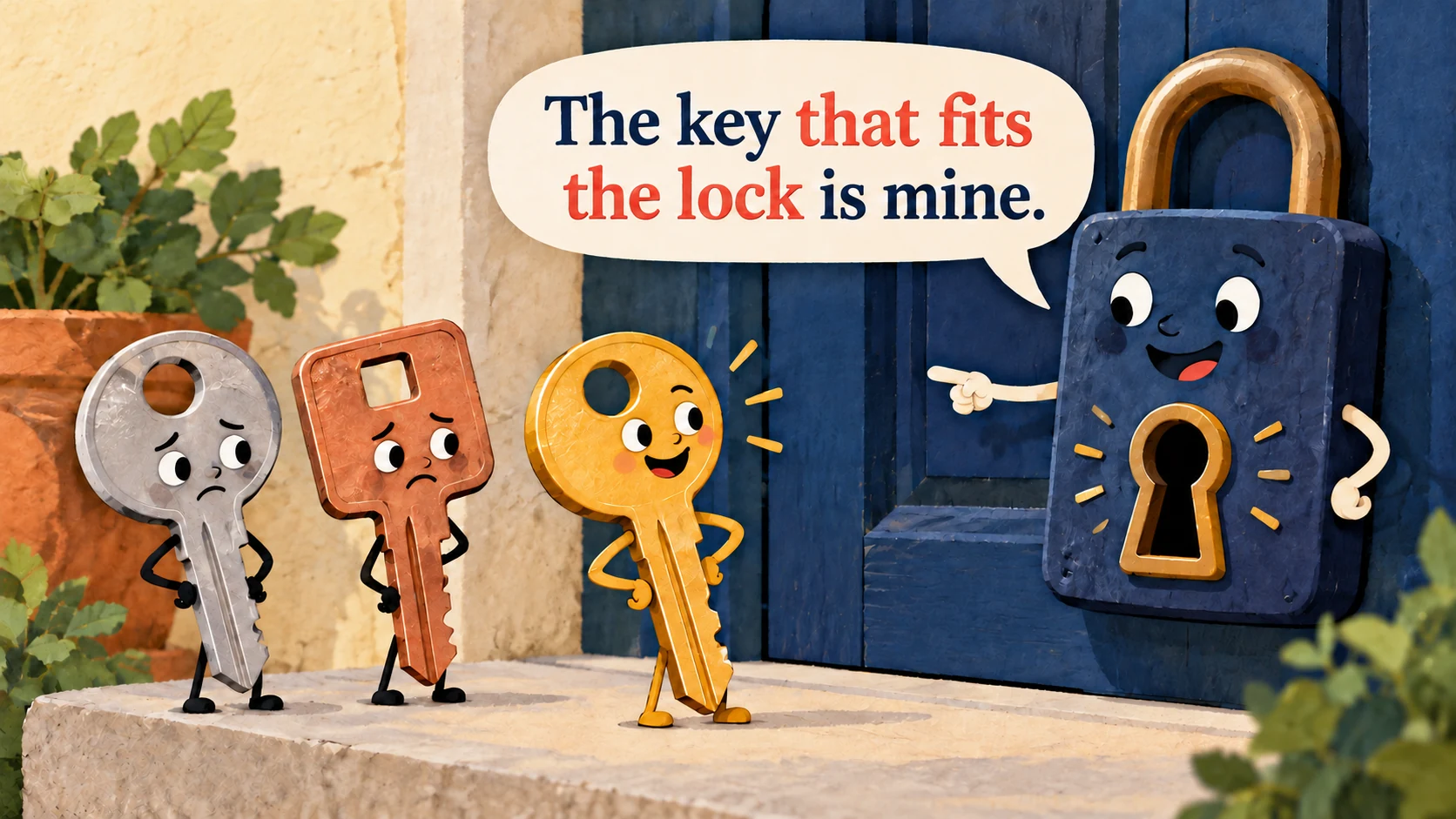
“The woman who lives next door is a doctor.” The relative clause tells us which woman we mean.
Why add a relative clause?
A defining relative clause identifies a person or thing. Without it, the listener may not know which one you mean:
- The book that you lent me is excellent.
- The student who won the prize is in my class.
In these examples, that you lent me and who won the prize are essential information. Do not separate a defining clause with commas.
Choose the relative word
| Use | Example |
|---|---|
| who for people | The neighbour who called is outside. |
| which or that for things | The phone that I bought is broken. |
| whose for possession | The girl whose bike was stolen has found it. |
| where for places | That’s the café where we met. |
That can also refer to people in a defining clause, especially in everyday English: The person that helped me was kind. Who is often clearer for people.
Join sentences by replacing the repeated person or thing
Start with I have a neighbour. My neighbour repairs bicycles. The repeated person can become who:
I have a neighbour who repairs bicycles.
Who repairs bicycles belongs next to neighbour, because that is the person it describes. The main sentence is I have a neighbour; the relative clause adds information that helps identify that neighbour.
Now join I bought a phone. The phone has a good camera:
I bought a phone that has a good camera.
That replaces the phone. Do not repeat it as it: a phone that it has a good camera is incorrect.
Identify the job of the relative word
| Separate sentence | Relative clause | Job |
|---|---|---|
| She helped me. | the woman who helped me | Who is the person doing the helping. |
| I helped her. | the woman who I helped | Who is the person receiving the help. |
This difference is called subject versus object. The subject does the action; the object receives it. It helps explain both word order and when a pronoun can be omitted.
The relative clause keeps statement word order: the book that I borrowed, not the book that did I borrow. It describes the book; it is not a question.
Subject or object?
In the student who won, who is the subject of won. In the student who I met, who is the object of met. This matters because an object relative word can sometimes be left out; the next lesson explains when.
Build the sentence by replacing the repeated noun: I know a woman. She designs games. → I know a woman who designs games.
Places, possession and time need the right connection
The café where we met means the café in which we met. Where supplies a place relationship. Compare The café that we visited, where the café is the object of visited.
That is why the café where we visited is incomplete if you mean you visited the café. Use that/which we visited, or where we met. You can also say the café we met in.
For possession, use whose + noun:
That's the student whose brother works here.
The brother belongs to the student in the sense of a family relationship. Who's is different: it means who is or who has, not possession.
For time, when is useful: I remember the day when we moved. In many such examples, when can be omitted: the day we moved.
Commas change the role of the information
The people who booked online received a discount identifies the online-booking group. The people, who booked online, received a discount treats the people as an identified group and adds that they booked online. The second is a different kind of relative clause, studied more fully at B2.
A defining clause does not need commas, even if it is long: The student who sits beside me in our Monday class speaks Portuguese.
To build a clear sentence, first decide which noun you are identifying. Then attach the relative clause directly after it. The woman who works at the bakery gave me directions is clearer than placing the description far away from woman. Finally, check that you have not repeated the noun inside the clause with he/she/it/them.
Sources and further reading
Try this structure in a short practice set with instant feedback.
Start practice