Articles and quantifiers
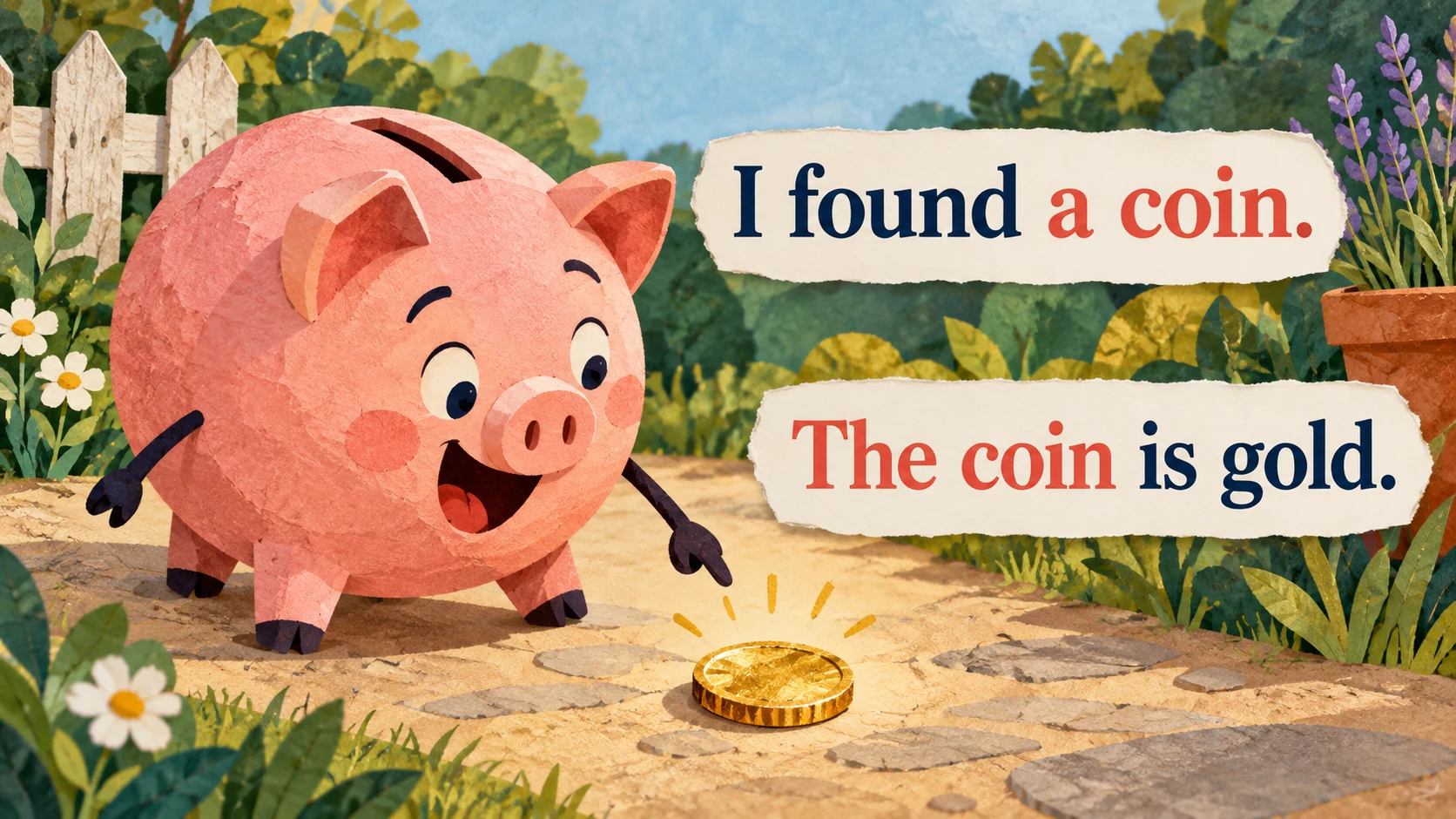
“I bought a book” introduces one book. “The book is excellent” points back to the book you now know. Small words guide the listener.
Choose an article from the noun and context
Use a/an with one singular countable noun when the listener does not yet know which one: I saw a dog. Choose an before a vowel sound: an umbrella, an hour.
Use the when the listener can identify the person or thing: The dog followed me home. It is now the dog just mentioned.
Use no article when talking generally about plural or uncountable nouns: Dogs need exercise. Water is important. A singular countable noun normally needs a determiner: a dog, the dog, my dog.
First decide whether you can count the noun
A countable noun has singular and plural forms: one apple, two apples. An uncountable noun normally names a substance, material or idea without separate counted items in that meaning: milk, rice, advice, information.
| Noun type | One item or an amount | A general statement |
|---|---|---|
| Singular countable | an apple, a chair | A chair needs to be comfortable. |
| Plural countable | some apples, three chairs | Apples are useful snacks. |
| Uncountable | some rice, a little milk | Rice is common in many dishes. |
Do not use a/an directly with an uncountable noun: an advice becomes some advice or a piece of advice. A container or unit can make an amount countable: two bottles of water, three pieces of information.
The helps the listener identify what you mean
I bought a notebook. The notebook is blue introduces an item, then refers back to it. But first mention can use the if the context identifies it: Please close the window is natural when both people can see the intended window.
Compare Books are expensive with The books on this shelf are expensive. The first is general; the second identifies a particular set. Uncountable nouns behave similarly: Water is important, but The water in this bottle is cold.
A/an follows sound rather than spelling: a university, an hour, an old book. If an adjective comes before the noun, its first sound matters too.
Add a quantity word
Some is common in affirmative statements: We bought some apples and some milk.
Any is common in questions and negatives: Do you have any milk? We don’t have any apples.
Use many with plural countable nouns and much with uncountable nouns: many books, much water. A lot of works with both: a lot of books, a lot of water.
Few/a few go with countable nouns; little/a little go with uncountable nouns. Adding a makes the amount sound more positive: We have a little time suggests some time is available; We have little time stresses a shortage.
Compare in context
I need a chair. Any suitable chair will do.
I need the chair by the door. The listener can identify it.
I need some chairs. The number is not exact.
Choose quantity and attitude together
Use many with plural countable nouns: many questions. Use much with uncountable nouns: much homework. In positive everyday statements, a lot of is often more natural: We have a lot of homework.
In questions and negatives, much/many are common: How much time do we have? There aren't many seats left.
A few means some countable items; a little means some uncountable amount. Without a, few/little often stress a shortage:
We have a few chairs, so the small group can sit down.
We have few chairs, so most people will have to stand.
The exact number can be the same; the speaker presents it differently.
Some and any are useful tendencies, not absolute rules
Some is common in positive statements; any in negatives and ordinary questions. But offers and requests often use some: Would you like some tea? Could I have some water? The speaker offers or expects a positive amount.
Positive any can mean “whichever”: Choose any seat. This differs from We don't have any seats left, where any occurs under a negative.
Imagine preparing lunch:
We need some bread and a few tomatoes. Do we have any cheese? There isn't much milk, but we have enough for coffee. The bread in the cupboard is fresh.
Each small word has a role: unspecified amount, small number, availability, limited amount, sufficient amount, or identified item.
To choose an article or quantity word, ask three questions: Can I count this noun in this meaning? Does the listener know which item or amount? How much or how many do I want to describe? These questions are more useful than trying to memorise every possible noun phrase.
Sources and further reading
Try this structure in a short practice set with instant feedback.
Start practice